Quote
"Well I know what Ive been told Youve to break free to break the mold But I cant do this all on my own No, I cant do this all on my own I know, that Im no Superman."
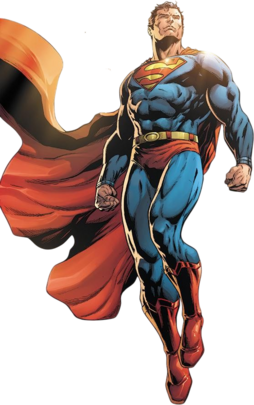 Superman
"When Superman was created during the Great Depression, he was the champion of the oppressed and fought on the side of the working man. He was lawless. If you were a wife beater, he’d throw you out the window. If you were a corrupt congressman, he’d swing you from the rooftops until you confessed. I think it appealed to people who were losing their jobs to machines: Suddenly you had Superman wrecking machines and punching robots. But his popularity has declined—nobody wants to be the son of a farmer now. American writers often say they find it difficult to write Superman. They say he’s too powerful; you can’t give him problems. But Superman is a metaphor. For me, Superman has the same problems we do, but on a Paul Bunyan scale. If Superman walks the dog, he walks it around the asteroid belt because it can fly in space. When Superman’s relatives visit, they come from the 31st century and bring some hellish monster conqueror from the future. But it’s still a story about your relatives visiting."
Superman is a superhero created by writer Jerry Siegel and artist Joe Shuster, first appearing in issue #1 of Action Comics, published in the United States on April 18, 1938. Superman has been regularly published in American comic books published by DC Comics since then, and has been adapted to other media including radio serials, novels, films, television shows, theater, and video games. Superman
"Well I know what Ive been told Youve to break free to break the mold But I cant do this all on my own No, I cant do this all on my own I know, that Im no Superman."
Superman"So Jerry and Joe plucked elements from the world around them to stir into their Superman stew. For the most part however, Superman’s millions of fans would ignore his origins. For them the Man of Steel would simply be the defender of the little man and woman-and a big problem for the forces of evil in the world."
Superman"A man who can see across the planet and wring diamonds from its anthracite."
Superman"I didnt bother getting into it with Tarantino about the Superman thing, because its not really true," chuckles Carradine. "Its not unique. The idea that Supermans analysis, whatever you want to call it, his image of the human race is Clark Kent, weak, a coward, fumbling, wearing glasses, uncertain of himself, not able to get a girl, all those kinds of things. Thats his idea about us and thats the point that Tarantino was trying to make. But the idea of Superman being unique in that he was born Superman, which is another point that Tarantinos trying to make, that thats what these people [Bill, etc.] are, these people are born warriors and they cant help it, but theres also the Silver Surfer, right? And theres Sub-Mariner..."
Superman"Superman has always defended vulnerable communities and he’s always been political, says Joseph Darowski, a professor at Brigham Young University. Darowski is also a comic historian and the editor of “The Ages of Superman: Essays on the Man of Steel in Changing Times.” “It’s an inevitable part of the comic book industry that politics is going to seep in,” Darowski says. “There’s always some reflection of what’s going on on the world stage.” In the 1940s, Superman tried to stop World War II. He’s taken on corrupt politicians and got political during the Cold War, too. “As America gets engaged in the space race, suddenly Superman’s enemies are coming from the stars more frequently,” Darowski says. “Kryptonite and other forms of radiation creeps into the stories after the dropping of the atomic bomb. During the Cold War and the nuclear arms race, Kryptonite becomes much more commonly used in Super-man stories, and villains who get their power through radiation also become much more common. These geopolitical events end up being adapted in fantastic ways into the Superman comics.”"
Superman"Rather than Clark be this clownish suit that Superman puts on, were going to really see Clark come into his own in the next few years as far as being a guy who takes to the Internet and to the airwaves and starts speaking an unvarnished truth."
Superman"As long as you keep getting born, it’s okay to die sometimes."
"The smart way to keep people passive and obedient is to strictly limit the spectrum of acceptable opinion, but allow very lively debate within that spectrum - even encourage the more critical and dissident views. That gives people the sense that theres free thinking going on, while all the time the presuppositions of the system are being reinforced by the limits put on the range of the debate."
"History is a strange experience. The world is quite small now; but history is large and deep. Sometimes you can go much farther by sitting in your own home and reading a book of history, than by getting onto a ship or an airplane and traveling a thousand miles. When you go to Mexico City through space, you find it a sort of cross between modern Madrid and modern Chicago, with additions of its own; but if you go to Mexico City through history, back only 500 years, you will find it as distant as though it were on another planet: inhabited by cultivated barbarians, sensitive and cruel, highly organized and still in the Copper Age, a collection of startling, of unbelievable contrasts."
"As soon as a thought or word becomes a tool, one can dispense with actually ‘thinking’ it, that is, with going through the logical acts involved in verbal formulation of it. As has been pointed out, often and correctly, the advantage of mathematics—the model of all neo-positivistic thinking—lies in just this ‘intellectual economy.’ Complicated logical operations are carried out without actual performance of the intellectual acts upon which the mathematical and logical symbols are based. … Reason … becomes a fetish, a magic entity that is accepted rather than intellectually experienced."
"Our feminist culture at the present moment is completely dependent on capitalism. My grandmother was still scrubbing clothes on the back porch on a washboard!"
"A word of the faith that never balks, Here or henceforward it is all the same to me, I accept Time absolutely. It alone is without flaw, it alone rounds and completes all, That mystic baffling wonder alone completes all. (23)"