SHAWORDS

You can argue truly enough, for example, that general respect for the — G. E. M. Anscombe

"You can argue truly enough, for example, that general respect for the prohibition on murder makes life more commodious. If people really respect the prohibition against murder life is pleasanter for all of us - but this argument is exceedingly comic. Because utility presupposes the life of those who are to be convenienced, and everybody perceives quite clearly that the wrong done in murder is done first and foremost to the victim, whose life is not inconvenienced, it just isnt there any more. He isnt there to complain; so the utilitarian argument has to be on behalf of the rest of us. Therefore, though true, it is highly comic and is not the foundation: the objection to murder is supra-utilitarian."
G. E. M. Anscombe
G. E. M. Anscombe
G. E. M. Anscombe
author10 quotes

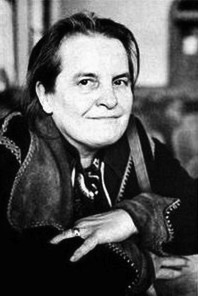
Gertrude Elizabeth Margaret Anscombe, usually cited as G. E. M. Anscombe or Elizabeth Anscombe, was a British analytic philosopher. She wrote on the philosophy of mind, philosophy of action, philosophical logic, philosophy of language, and ethics. She was a prominent figure of analytical Thomism, a fellow of Somerville College, Oxford, and a professor of philosophy at the University of Cambridge.

More by G. E. M. Anscombe

View all →
Quote
"There is no such thing as a casual, non-significant sexual act; everyone knows this. Contrast sex with eating - youre strolling along a lane, you see a mushroom on a bank as you pass by, you know about mushrooms, you pick it and you eat it quite casually - sex is never like that. Thats why virtue in connection with eating is basically a matter only of the pattern of ones eating habits. But virtue in sex - chastity - is not only a matter of such a pattern, that is of its role in a pair of lives. A single sexual action can be bad even without regard to its context, its further intentions and its motives."
G. E. M. AnscombeG. E. M. Anscombe
Quote
"A severe morality holds that intercourse (and may hold this of eating, too) has something wrong about it if it is ever done except explicitly as being required for that preservation of human life which is what makes intercourse a good kind of action. But this involves thoroughly faulty moral psychology. God gave us our physical appetite, and its arousal without our calculation is part of the working of our sort of life. Given moderation and right circumstances, acts prompted by inclination can be taken in a general way to accomplish what makes them good in kind and theres no need for them to be individually necessary or useful for the end that makes them good kinds of action. Intercourse is a normal part of married life through the whole life of the partners in a marriage and is normally engaged in without any distinct purpose other than to have it, just as such a part of married life."
G. E. M. AnscombeG. E. M. Anscombe
Quote
"If a kind of love cannot be commanded, we cant build our moral theology of marriage on the presumption that it will be present. Its absence is sad, but this sadness exists, it is very common. We should avoid, I think, using the indicative mood for what is really a commandment like the Scout Law ("A Boy Scout is kind to animals" - it means a Boy Scout ought to be kind to animals). For if we hear: "a Christian couple grow in grace and love together" doesnt the question arise "supposing they dont?" It clears the air to substitute the bite of what is clearly a precept for the sweetness of a rosy picture. The command to a Christian couple is: "Grow in grace and love together." But a joint command can only be jointly obeyed. Suppose it isnt? Well, there remains the separate precept to each and in an irremediably unhappy marriage, one ought still to love the other, though not perhaps feeling the affection that cannot be commanded. Thus the notion of the "marriage debt" is a very necessary one, and it alone is realistic: because it makes no assumption as to the state of the affections. Looking at the rightness of the marriage act like this will help in another way. It will prevent us from assuming that the pleasant affection which exists between a happy and congenial pair is the fulfilment of the precept of love. (It may after all only be a complacent hiving off together in a narrow love.) We ought absolutely not to give out a teaching which is flattering to the lucky, and irrelevant to the unhappy. Looked at carefully, too, such teaching is altogether too rigorist in a new direction. People who are not quite happily married, not lucky in their married life, but nevertheless have a loyalty to the bond, are not, therefore, bound to abstain from intercourse."
G. E. M. AnscombeG. E. M. Anscombe
Quote
"But we lay people are not less called to the Christian life, in which the critical question is: "Where does the compass-needle of your mind and will point?" This is tested above all by our reactions when it costs or threatens to cost something to be a Christian. One should be glad if it does, rather than complain! If we will not let it cost anything; if we succumb to the threat of "losing our life", then our religion is indistinguishable from pure worldliness."
G. E. M. AnscombeG. E. M. Anscombe
Quote
"Intention appears to be something that we can express, but which brutes (which e.g. do not give orders) can have, though lacking any distinct expression of intention. For a cats movements in stalking a bird are hardly to be called an expression of intention. One might as well call a cars stalling the expression of its being about to stop. Intention is unlike emotion in this respect, that the expression of it is purely conventional; we might say linguistic, if we will allow certain bodily movements with a conventional meaning to be included in language."
G. E. M. AnscombeG. E. M. Anscombe

More on Life

View all →