SHAWORDS
John Dewey

John Dewey

John Dewey

John Dewey

author
85Quotes

John Dewey was an American philosopher, psychologist, and educational reformer. He was one of the most prominent American scholars in the first half of the twentieth century.

Popular Shayari

85 total
Quote
"There are in our minds in solution a vast number of emotional attitudes, feelings ready to be re-excited when the proper stimulus arrives, and more than anything else it is these forms, this residue of experience, which, fuller and richer than in the mind if the ordinary man, constitute the artist’s capital. What is called the magic of the artist resides in his ability to transfer these values from one field of experience to another, to attach them to objects of our common life, and by his imaginative insight make these objects poignant and momentous. Not colors, not sense qualities as such, are either matter or form, but these qualities as thoroughly imbued, impregnated, with transferred value. And then they are either matter or form according to the direction of our interest."
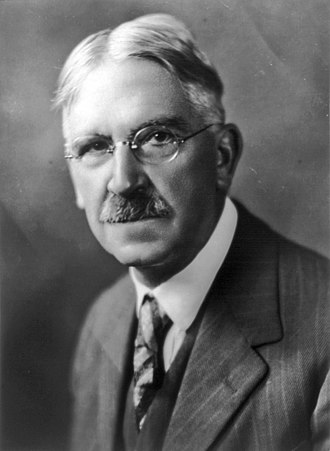
John DeweyJohn Dewey
Quote
"Such external or mere means, as we properly term them, are usually of such a sort that others can be substituted for them; the particular ones employed are determined by some extraneous consideration, like cheapness. But the moment we say “media”, we refer to means that are incorporated in the outcome. Even bricks and mortar become part of the house they are employed to build; they are not mere means to its erection. Colors are the painting; tones are the music. A picture painted with water colors has a quality different from that painted with oil. Esthetic effects belong intrinsically to their medium; when another medium is substituted, we have a stunt rather than an object of art. Even when substitution is practiced with the utmost virtuosity or for any reason outside the kind of end desired, the product is mechanical or a tawdry sham — like boards painted to resemble stone in the construction of a cathedral, for stone is integral not just physically, but to the esthetic effect."
John DeweyJohn Dewey
Quote
"... classic philosophy maintained that change, and consequently time, are marks of inferior reality, holding that true and ultimate reality is immutable and eternal. Human reasons, all too human, have given birth to the idea that over and beyond the lower realm of things that shift like the sands on the seashore there is the kingdom of the unchanging, of the complete, the perfect. The grounds for the belief are couched in the technical language of philosophy, but the grounds for the cause is the hearts desire for surcease from change, struggle, and uncertainty. The eternal and immutable is the consummation of mortal mans quest for certainty."
John DeweyJohn Dewey
Quote
"The animating purpose of James was, on the other hand, primarily moral and artistic. It is expressed in his phrase, "block universe," employed as a term of adverse criticism. Mechanism and idealism were abhorrent to him because they both hold to a closed universe in which there is no room for novelty and adventure. Both sacrifice individuality and all the values, moral and aesthetic, which hang upon individuality; for according to absolute idealism, as to mechanistic materialism, the individual is simply a part determined by the whole of which he is a part. Only a philosophy of pluralism, of genuine indetermination, and of change which is real and intrinsic gives significance to individuality. It alone justifies struggle in creative activity and gives opportunity for the emergence of the genuinely new."
John DeweyJohn Dewey
Quote
"There can be no movement toward a consummating close unless there is a progressive massing of values, a cumulative effect. This result cannot exist without conservation of the import of what has gone before. Moreover, to secure the needed continuity, the accumulated experience must be such as to create suspense and anticipation of resolution. Accumulation is at the same time preparation, as with each phase of the growth of a living embryo. Only that is carried on which is led to; otherwise there is arrest and a break. For this reason consummation is relative; instead of occurring once for all at a given point, it is recurrent. The final end is anticipated by rhythmic pauses, while that end is final only in an external way. For as we turn from reading a poem or novel or seeing a picture the effect presses forward in further experiences, even if only subconsciously."
John DeweyJohn Dewey
Quote
"We have to a considerable extent, given up thinking of this life as merely a preparation for another life. Very largely, however, we think of some parts of this life as merely preparatory to other later stages of it. It is so very largely as to the process of education; and if I were asked to name the most needed of all reforms in the spirit of education, I should say: Cease conceiving of education as mere preparation for later life, and make it the full meaning of the present life. And to add that only in this case does it become truly a preparation for after life is not the paradox it seems. An activity which does not have worth enough to be carried on for its own sake cannot be very effective as a preparation for something else. By making the present activity the expression of the full meaning of the case, that activity is, indeed, an end in itself, not a mere means to something beyond itself; but, in being a totality, it is also the condition of all future integral action. It forms the habit of requiring that every act be an outlet of the whole self, and it provides the instruments of such complete functioning."
John DeweyJohn Dewey
Quote
"I do not think that the dancing and singing of even little children can be explained wholly on the basis of unlearned and unformed responses to then existing objective conditions. Clearly there must be something in the present to evoke happiness. But the act is expressive only a there is in it a unison of something stored from past experience, something therefore generalized, with present conditions. In the case of expressions of happy children the marriage of past values and present incidents takes place easily; there are few obstructions to be overcome, few wounds to heal, few conflicts to resolve. With maturer persons, the reverse is the case. Accordingly the achievement of complete unison is rare; but when it occurs it is so on a deeper level and with a fuller content of meaning. And then, even though after long incubation and after precedent pangs of labor, the final expression may issue with the spontaneity of the cadenced speech or rhythmic movement of happy childhood."
John DeweyJohn Dewey

Similar Authors & Thinkers



