SHAWORDS
Laozi

Laozi

Laozi

Laozi

author
49Quotes

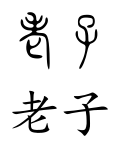
Laozi, also spelt as Lao Tzu and Laou-tsze, was a legendary Chinese philosopher considered to be the author of the Tao Te Ching, one of the foundational texts of Taoism. Modern scholarship generally regards his biographical details as later inventions and his opus a collaboration of various writers, with the name Laozi, literally meaning 'Old Master', likely intended to portray an archaic anonymit

Popular Quotes

49 total
Quote
"The Tao that can be expressed is not the eternal Tao; The name that can be defined is not the unchanging name. Non-existence is called the antecedent of heaven and earth; Existence is the mother of all things. From eternal non-existence, therefore, we serenely observe the mysterious beginning of the Universe; From eternal existence we clearly see the apparent distinctions. These two are the same in source and become different when manifested. This sameness is called profundity. Infinite profundity is the gate whence comes the beginning of all parts of the Universe."
LaoziLaozi
Quote
"The oldest known Chinese sage is Lao-Tze, the founder of Taoism. "Lao Tze" is not really a proper name, but means merely "the old philosopher." He was (according to tradition) an older contemporary of Confucius, and his philosophy is to my mind far more interesting. He held that every person, every animal, and every thing has a certain way or manner of behaving which is natural to him, or her, or it, and that we ought to conform to this way ourselves and encourage others to conform to it. "Tao" means "way," but used in a more or less mystical sense, as in the text: "I am the Way and the Truth and the Life." I think he fancied that death was due to departing from the "way," and that if we all lived strictly according to nature we should be immortal, like the heavenly bodies."
LaoziLaozi
Quote
"Truthful words are not fancy; fancy words are not truthful. The good are not argumentative; the argumentative are not quite good. The wise know the truth not by storing up knowledge; those who focus on storing up knowledge do not know the truth. The sage does not hoard for herself. The more she helps others, the richer life she lives. The more she gives to others, the more abundance she realizes. The Tao of heaven benefits all beings without harming anyone. The Tao of the sage assists the people without competing with anyone."
LaoziLaozi
Quote
"According to religious scholar Huston Smith, Taoism has only one basic text, the Tao Te Ching (or, in English, The Way and Its Power), a slim volume that, as Smith says, can be read in half an hour or a lifetime. Legend has it that a Chinaman by the name of Lao Tzu one day said "Enough!" (loosely translated from the Chinese), hopped on a water buffalo (possibly with rust coloration), and started heading a-way out west to Tibet. On his way out, someone stopped Lao Tzu and asked if he would write down the tenets of his ethos before leaving town. Being a lazy man, Lao Tzu lodged his water buffalo against an abutment long enough to write the Tao Te Chings 81 short verses. When finished, he kicked his water buffalo into gear and, tossing his ringer to the man, rode off into the misty horizon of legend and myth. Regardless of whether the legend is true, or whether Lao Tzu even really existed, the Chinaman is not the issue here, Dudes. The issue is that the Tao Te Ching is the perfect expression of Taoisms wu wei of life, or in the parlance of Huston Smith, a life of creative quietude in which "the conscious mind must relax, stop standing in its own light, let go" so that it can flow with the Tao (or Way) of the universe."
LaoziLaozi
Quote
"Helpmeat too, contrasta toga, his fiery goosemother, laotsey taotsey, woman who did, he tell princes of the age about. You sound on me, judges! Suppose we brisken up. Kings! Meet the Mem, Avenlith, all viviparous out of couple of lizards. She just as fenny as he is fulgar. How laat soever her latest still her sawlogs come up all standing. Psing a psalm of psexpeans, apocryphul of rhyme! His cheekmole of allaph foriverever her allinall and his Quran never teach it her the be the owner of thyself."
LaoziLaozi
Quote
"If there is one book in the whole of Oriental literature which one should read above all the others, it is, in my opinion, Laotses Book of Tao. If there is one book that can claim to interpret for us the spirit of the Orient, or that is necessary to the understanding of characteristic Chinese behaviour, including literally "the ways that are dark," it is the Book of Tao. For Laotses book contains the first enunciated philosophy of camouflage in the world; it teaches the wisdom of appearing foolish, the success of appearing to fail, the strength of weakness and the advantage of lying low, the benefit of yielding to your adversary and the futility of contention for power. It accounts in fact for any mellowness that may be seen in Chinese social and individual behaviour. If one reads enough of this Book, one automatically acquires the habit and ways of the Chinese. I would go further and say that if I were asked what antidote could be found in Oriental literature and philosophy to cure this contentious modern world of its inveterate belief in force and struggle for power, I would name this book of "5,000 words" written some 2,400 years ago. For Laotse (born about 570 B.C.) has the knack of making Hitler and other dreamers of world mastery appear foolish and ridiculous. The chaos of the modem world, I believe, is due to the total lack of a philosophy of the rhythm of life such as we find in Laotse and his brilliant disciple Chuangtse, or anything remotely resembling it. And furthermore, if there is one book advising against the multifarious activities and futile busyness of the modern man, I would again say it is Laotses Book of Tao. It is one of the profoundest books in the worlds philosophy."
LaoziLaozi
Quote
"The Tao is teachable, yet understanding my words is not the same as following the Tao. The guidance is describable, yet knowing the description is not the same as following the guidance. Non-Being guides to the origin of Heaven and Earth. Being guides to the mother of all particular things. Thus, through the guidance of Non-Being, you can observe the beginning; through the guidance of Being, you can observe the returning. Non-Being and Being come out concurrently, but point to different directions; both together can be called the mysterious transforming power. They constantly transform into each other, and form the gateways for all wonderful things."
LaoziLaozi

Similar Authors & Thinkers