Quote
"Evening, thou that bringest all that bright morning scattered; thou bringest the sheep, the goat, the child back to her mother."
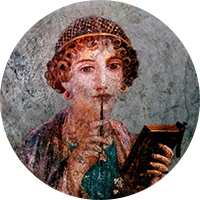 Sappho
Sappho
Sappho
"Evening, thou that bringest all that bright morning scattered; thou bringest the sheep, the goat, the child back to her mother."
Sappho"I wanted to hear Sappho’s laughter and the speech of her stringed shell.What I heard was whiskered mumble- ment of grammarians:Greek pterodactyls and Victorian dodos."
Sappho"Sweet mother, I truly cannot weave my web; for I am o’erwhelmed through Aphrodite with love of a slender youth."
Sappho"Immortal Aphrodite of the shimmering throne, daughter of Zeus, weaver of wiles, I pray thee crush not my spirit with anguish and distress, O Queen. But come hither if ever before thou didst hear my voice afar, and hearken, and leaving the golden house of thy father, camest with chariot yoked, and swift birds drew thee, their swift pinions fluttering over the dark earth, from heaven through mid-space. Quickly they arrived; and thou blessed one with immortal countenance smiling didst ask: What now is befallen me and why now I call and what I in my heart’s madness, most desire. What fair one now wouldst thou draw to love thee? Who wrongs thee Sappho? For even if she flies she shall soon follow and if she rejects gifts, shall soon offer them and if she loves not shall soon love, however reluctant. Come I pray thee now and release me from cruel cares, and let my heart accomplish all that it desires, and be thou my ally."
Sappho"Do thou, O Dica, set garlands upon thy lovely hair, weaving sprigs of dill with thy delicate hands; for those who wear fair blossoms may surely stand first, even in the presence of Goddesses who look without favour upon those who come ungarlanded."
Sappho"Truly, I wish I were dead. She was weeping when she left me, and said many things to me, and said this: "How much we have suffered, Sappho. Truly, I dont want to leave you."
Sappho"One of the earliest -- and perhaps the first -- rivals of the hymnology of war, hatred, and revenge made immortal by Homer was the poetry of an Aeolian woman called Sappha by her people but uniformly known to later times as Sappho...Much of Sapphos poetry was of a plaintive tenderness but she had a fervid feeling for love as a saving grace. Several of her feminine disciples also sang of the beauty and healing force of love. Solon the law-giver and Plato the philosopher were deeply affected by her hymns to the great idea of a social power unrecognized by "the Bible of the Greeks": Homer. Though Attic poets and playwrights tried to destroy her by attacking her as a courtesan or "Lesbian" pervert, the German classical scholar, Welcker, in his Kleine Schriften, declares that such attacks were sheer calumny. Nor did they succeed in their aim. More than twenty centuries have honored the "sweet singer" of Aeolia."
Sappho"When everybody says "lesbian," a word connected with Sappho and the island of Lesbos, that automatically means that your forefathers and foremothers are European, that George Washington is the father of our country and Columbus discovered America-all false assumptions."
Sappho"Thomas Moore, Evenings in Greece (1826) p. 18"
Sappho"And of the flowers of Sappho few, but roses."
Sappho"Some say cavalry and others claim infantry or a fleet of long oars is the supreme sight on the black earth. I say it isthe one you love. And easily proved. Didnt Helen, who far surpassed all mortals in beauty, desert the best of men, her king,and sail off to Troy and forget her daughter and her dear parents? Merely Aphrodites gaze made her readily bend and led her farfrom her path. These tales remind me now of Anaktoria who isnt here, yet I for onewould rather see her warm supple step and the sparkle in her face than watch all the chariots in Lydia and foot soldiers armored in glittering bronze."
Sappho"Of course I am downcast and tremble with pity for my state when old age and wrinkles cover me,when Eros flies about and I pursue the glorious young. Pick up your lyreand sing to us of her who wears violets on her breasts. Sing especially of her who is wandering."
Sappho