Quote
"I entered literary life as a meteor, and I shall leave it like a thunderbolt."
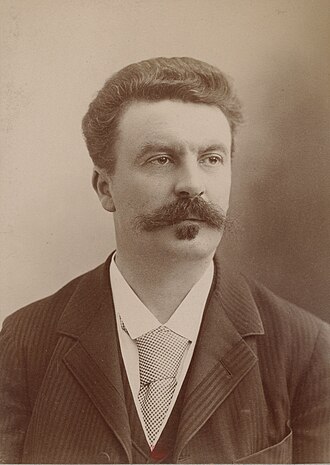 Guy de Maupassant
"At first no one spoke. Boule de Suif dared not even raise her eyes. She felt at once indignant with her neighbors, and humiliated at having yielded to the Prussian into whose arms they had so hypocritically cast her."
Henri René Albert Guy de Maupassant was a 19th-century French author, celebrated as a master of the short story and associated with the naturalist literary school of thought, depicting human lives, destinies, and social forces in disillusioned and often pessimistic terms.
"I entered literary life as a meteor, and I shall leave it like a thunderbolt."
Guy de Maupassant"There are in France some fifty thousand young men of good birth and fairly well off who are encouraged to live a life of complete idleness. They must either cease to exist or must come to see that there can be no happiness, no health even, without regular daily labor of some sort … The need of work is in me."
Guy de Maupassant"The same thing happens whenever the established order of things is upset, when security no longer exists, when all those rights usually protected by the law of man or of Nature are at the mercy of unreasoning, savage force. The earthquake crushing a whole nation under falling roofs; the flood let loose, and engulfing in its swirling depths the corpses of drowned peasants, along with dead oxen and beams torn from shattered houses; or the army, covered with glory, murdering those who defend themselves, making prisoners of the rest, pillaging in the name of the Sword, and giving thanks to God to the thunder of cannon — all these are appalling scourges, which destroy all belief in eternal justice, all that confidence we have been taught to feel in the protection of Heaven and the reason of man."
Guy de Maupassant"In the cold light of the morning they almost bore a grudge against the girl for not having secretly sought out the Prussian, that the rest of the party might receive a joyful surprise when they awoke. What more simple? Besides, who would have been the wiser? She might have saved appearances by telling the officer that she had taken pity on their distress. Such a step would be of so little consequence to her. But no one as yet confessed to such thoughts."
Guy de Maupassant"Let us protest and let us be angry, let us be indignant, or let us be enthusiastic, Schopenhauer has marked humanity with the seal of his disdain and of his disenchantment. A disabused pleasure-seeker, he overthrew beliefs, hopes, poetic ideals and chimeras, destroyed the aspirations, ravaged the confidence of souls, killed love, dragged down the chivalrous worship of women, crushed the illusions of hearts, and accomplished the most gigantic task ever attempted by scepticism. He spared nothing with his mocking spirit, and exhausted everything. And even to-day those who execrate him seem to carry in their own souls particles of his thought."
Guy de Maupassant"For several days in succession fragments of a defeated army had passed through the town. They were mere disorganized bands, not disciplined forces. The men wore long, dirty beards and tattered uniforms; they advanced in listless fashion, without a flag, without a leader. All seemed exhausted, worn out, incapable of thought or resolve, marching onward merely by force of habit, and dropping to the ground with fatigue the moment they halted."
Guy de Maupassant