SHAWORDS

Evolution in... cases has clearly been a very slow and almost (if not — J. B. S. Haldane

"Evolution in... cases has clearly been a very slow and almost (if not quite) continuous process, exactly as Darwin had predicted. We must remember, however, that the organisms studied in this way are far from representative. They are in general the most successful members of animal associations living in very constant marine or lacustrine environments. We have not got similar data for land species... Nor do we possess them for the rarer forms. We shall see... that perhaps dominant species in a uniform environment are the least likely to undergo sudden change to a new type."
J
J. B. S. Haldane
J. B. S. Haldane
author33 quotes

John Burdon Sanderson Haldane, nicknamed "Jack" or "JBS", was a British-born scientist who later moved to India and acquired Indian citizenship. He worked in the fields of physiology, genetics, evolutionary biology, and mathematics. With innovative use of statistics in biology, he was one of the founders of neo-Darwinism. Despite his lack of an academic degree in the field, he taught biology at th

More by J. B. S. Haldane

View all →
Quote
"The commonest cause of gastritis – that is to say, an inflamed and irritable stomach – is worry and anxiety. It is particularly common among busmen and travelling salesmen. I had it for about fifteen years until I read Lenin and other writers, who showed me what was wrong with our society and how to cure it. Since then I have needed no magnesia. But these pains may also be due to gastric ulcer or even cancer. So it is better to consult a doctor, even though he will probably recommend magnesia. But the Daily Worker may effect a permanent cure."
J
J. B. S. Haldane
Quote
"Science is as yet in its infancy, and we can foretell little of the future save that the thing that has not been is the thing that shall be; that no beliefs, no values, no institutions are safe. So far from being an isolated phenomenon the late war is only an example of the disruptive result that we may constantly expect from the progress of science. The future will be no primrose path. It will have its own problems. Some will be the secular problems of the past, giant flowers of evil blossoming at last to their own destruction. Others will be wholly new. Whether in the end man will survive his ascensions of power we cannot tell. But the problem is no new one. It is the old paradox of freedom re-enacted with mankind for actor and the earth for stage...But it is only hopeful if mankind can adjust its morality to its powers."
J
J. B. S. Haldane
Quote
"The time has gone by when a Huxley could believe that while science might indeed remould traditional mythology, traditional morals were impregnable and sacrosanct to it. We must learn not to take traditional morals too seriously. And it is just because even the least dogmatic of religions tends to associate itself with some kind of unalterable moral tradition, that there can be no truce between science and religion. There does not seem to be any particular reason why a religion should not arise with an ethic as fluid as Hindu mythology, but it has not yet arisen. Christianity has probably the most flexible morals of any religion, because Jesus left no code of law behind him like Moses or Muhammad, and his moral precepts are so different from those of ordinary life that no society has ever made any serious attempt to carry them out, such as was possible in the case of Israel and Islam. But every Christian church has tried to impose a code of morals of some kind for which it has claimed divine sanction. As these codes have always been opposed to those of the gospels a loophole has been left for moral progress such as hardly exists in other religions. This is no doubt an argument for Christianity as against other religions, but not as against none at all, or as against a religion which will frankly admit that its mythology and morals are provisional. That is the only sort of religion that would satisfy the scientific mind, and it is very doubtful whether it could properly be called a religion at all."
J
J. B. S. Haldane

More on Time

View all →
Quote
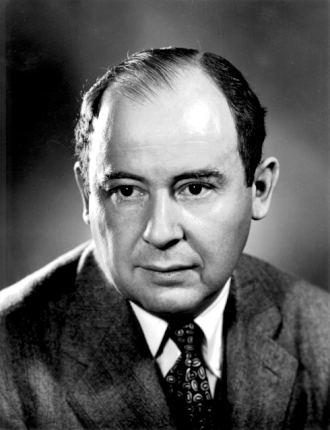
"Most mathematicians prove what they can, von Neumann proves what he wants." Once in a discussion about the rapid growth of mathematics in modern times, von Neumann was heard to remark that whereas thirty years ago a mathematician could grasp all of mathematics, that is impossible today. Someone asked him: "What percentage of all mathematics might a person aspire to understand today?" Von Neumann went into one of his five-second thinking trances, and said: "About 28 percent."
John von NeumannJohn von Neumann