Quote
"The office of the lawyer, however poorly filled, is too delicate, personal and confidential to be occupied by a corporation."
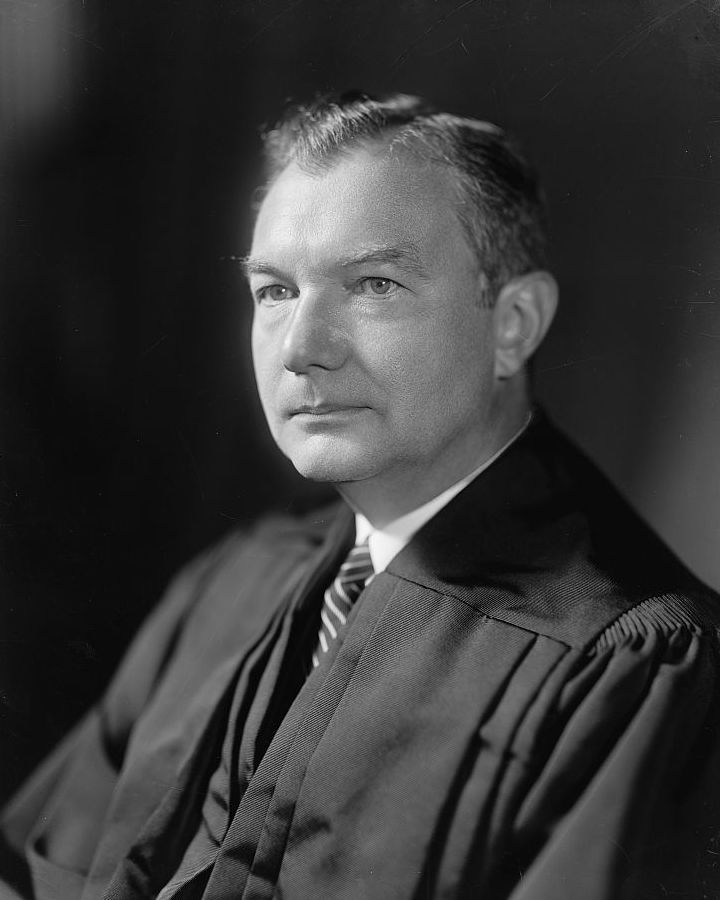 Robert H. Jackson
"He had a quiet courage, which never led to a bellow of defiance but which permitted him to take in every instance the action he thought best without discernible thought of criticism or personal injury. He was modest in manner, yet supremely confident of himself and his judgment. He had a calm which no crisis could disturb, and standards of honorable conduct which were both rigorous and unshakeable."
Robert Houghwout Jackson was an American lawyer, jurist, and politician who served as an associate justice of the U.S. Supreme Court from 1941 until his death in 1954. He had previously served as United States Solicitor General and United States Attorney General, and is the only person to have held all three of those offices. Jackson was also notable for his work at the Nuremberg trials prosecutin
"The office of the lawyer, however poorly filled, is too delicate, personal and confidential to be occupied by a corporation."
Robert H. Jackson"I used to say that, as Solicitor General, I made three arguments in every case. First came the one I had planned – as I thought, logical, coherent, complete. Second was the one actually presented – interrupted, incoherent, disjointed, disappointing. The third was the utterly devastating argument that I thought of after going to bed that night…"
Robert H. Jackson"Our people do not want barren theories from their democracy. Maury Maverick has expressed very quaintly, but clearly, what they really want when he says: We Americans want to talk, pray, think as we please — and eat regular."
Robert H. Jackson"There is a most important reason why the prosecutor should have, as nearly as possible, a detached and impartial view of all groups in his community. Law enforcement is not automatic. It isnt blind. One of the greatest difficulties of the position of prosecutor is that he must pick his cases, because no prosecutor can even investigate all of the eases in which he receives complaints. If the department of justice were to make even a pretense of reaching every probable violation of federal law, ten times its present staff would be inadequate. We know that no local police force can strictly enforce the traffic laws, or it would arrest half the driving population on any given morning, [sic!] What every prosecutor is practically required to do is to select the cases for prosecution and to select those in which the offense is the most flagrant, the public harm the greatest, and the proof the most certain."
Robert H. Jackson"Any prosecutor who risks his day-to-day professional name for fair dealing to build up statistics of success has a perverted sense of practical values, as well as defects of character. Whether one seeks promotion to a. judgeship, as many prosecutors rightly do, or whether he returns to private practice, he can have no better asset than to have his profession recognize that his attitude toward those who feel his power has been dispassionate, reasonable and just."
Robert H. Jackson"He loved his profession, he had a real sense of dedication to the administration of justice, he held his head high as a lawyer, he rendered and exacted courtesy, honor and straightforwardness at the Bar. He respected the judicial office deeply, demanded the highest standards of competence and disinterestedness and dignity, despised all political use of or trifling with judicial power, and had an affectionate regard for every man who filled the exacting prescription of the just judge. The law to him was like a religion, and its practice was more than a means of support; it was a mission. He was not always popular in his community, but he was respected. Unpopular minorities and individuals often found in him their only mediator and advocate. He was too independent to court the populace - he thought of himself as a leader and lawgiver, not a mouthpiece."
Robert H. Jackson"The smart way to keep people passive and obedient is to strictly limit the spectrum of acceptable opinion, but allow very lively debate within that spectrum - even encourage the more critical and dissident views. That gives people the sense that theres free thinking going on, while all the time the presuppositions of the system are being reinforced by the limits put on the range of the debate."
"There is no ethical idea which it [dharma] has not stressed, put in its most ideal and imperative form, enforced by teaching, injunction, parable, artistic creation, formative examples. Truth, honour, loyalty, fidelity, courage, chastity, love, long-suffering, self-sacrifice, harmlessness, forgiveness, compassion, benevolence, beneficence are its common themes, are, in its view, the very stuff of a right human life, the essence of mans dharma. Buddhism, with its high and noble ethics, Jainism, with its austere ideal of self-conquest, Hinduism, with its magnificent examples of all sides of the Dharma, are not inferior in ethical teaching and practice to any religion or system, but rather take the highest rank and have had the strongest effective force."
"Moving forward will not be for the faint of heart. But if the next century witnesses failure, let it be because our science is not yet up to the job, not because we dont have the courage to make less random the sometimes most unfair courses of human evolution."
"Our units of temporal measurement, from seconds on up to months, are so complicated, asymmetrical and disjunctive so as to make coherent mental reckoning in time all but impossible. Indeed, had some tyrannical god contrived to enslave our minds to time, to make it all but impossible for us to escape subjection to sodden routines and unpleasant surprises, he could hardly have done better than handing down our present system. It is like a set of trapezoidal building blocks, with no vertical or horizontal surfaces, like a language in which the simplest thought demands ornate constructions, useless particles and lengthy circumlocutions. Unlike the more successful patterns of language and science, which enable us to face experience boldly or at least level-headedly, our system of temporal calculation silently and persistently encourages our terror of time. ... It is as though architects had to measure length in feet, width in meters and height in ells; as though basic instruction manuals demanded a knowledge of five different languages. It is no wonder then that we often look into our own immediate past or future, last Tuesday or a week from Sunday, with feelings of helpless confusion."
"We must present democracy as a force holding within itself the seeds of unlimited progress by the human race. By our actions we should make it clear that such a democracy is a means to a better way of life, together with a better understanding among nations. Tyranny inevitably must retire before the tremendous moral strength of the gospel of freedom and self-respect for the individual, but we have to recognize that these democratic principles do not flourish on empty stomachs, and that people turn to false promises of dictators because they are hopeless and anything promises something better than the miserable existence that they endure. However, material assistance alone is not sufficient. The most important thing for the world today in my opinion is a spiritual regeneration which would reestablish a feeling of good faith among men generally. Discouraged people are in sore need of the inspiration of great principles. Such leadership can be the rallying point against intolerance, against distrust, against that fatal insecurity that leads to war. It is to be hoped that the democratic nations can provide the necessary leadership."
"James Baker was the only leader in America who had the guts to stand up and act against Israels malignant disease: the settlements. When he was the Secretary of State, he simply informed the Israeli government that he would deduct the sums expended on the settlements from the money Israel was getting from the US. Threatened and made good on his threat. Baker thus confronted the "pro-Israeli" lobby in the US, both the Jewish and the Christian. Such courage is rare in the United States, as it is rare in Israel."