Quote
"That he is mad, tis true; tis true tis pity; And pity tis tis true: a foolish figure; But farewell it, for I will use no art."
 Hamlet
"I could be bounded in a nutshell, and count myself a king of infinite space, were it not that I have bad dreams."
The Tragedy of Hamlet, Prince of Denmark, often shortened to Hamlet, is a tragedy written by William Shakespeare sometime between 1599 and 1601. It is Shakespeare's longest play. Set in Denmark, the play depicts Prince Hamlet and his attempts to exact revenge against his uncle, Claudius, who has murdered Hamlet's father in order to seize his throne and marry Hamlet's mother.
"That he is mad, tis true; tis true tis pity; And pity tis tis true: a foolish figure; But farewell it, for I will use no art."
Hamlet"What art thou that usurp’st this time of night, Together with that fair and warlike form In which the majesty of buried Denmark Did sometimes march? By heaven I charge thee speak!"
Hamlet"He was a man, take him for all in all, I shall not look upon his like again."
Hamlet"Good Hamlet, cast thy nighted color off, And let thine eye look like a friend on Denmark. Do not be forever with thy vailed lids Seek for thy noble father in the dust: Thou knowst tis common; all that lives must die, Passing through nature to eternity."
Hamlet"The lady doth protest too much, methinks."
Hamlet"Give every man thy ear, but few thy voice; Take each mans censure, but reserve thy judgment."
Hamlet"Our concern with environment cannot be reduced to what can be used, to what can be grasped. Environment includes not only the inkstand and the blotting paper, but also the impenetrable stillness in the air, the stars, the clouds, the quiet passing of time, the wonder of my own being. I am an end as well as a means, and so is the world: an end as well as a means. My view of the world and my understanding of the self determine each other. The complete manipulation of the world results in the complete instrumentalization of the self."
"[Relationships] never seem to work out, I mean it gets to the point where I have to be extremely cautious. You have to understand, this stardom thing is still new to me, I dont even consider myself "famous". Its 2008: if you have a blog, a mixtape and two pairs of skinny jeans you, too, can be famous."
"Critics of the war plans (including myself) have pointed to the disastrous political results that must be expected: Iraq would break into three parts (Kurds in the north, Sunnis in the center, Shi’ites in the south), the Middle East would be exposed to the onslaught of Iranian fanaticism, pro-Western Arab regimes would collapse. Israel would be surrounded by aggressive Islamic fundamentalism, like the Crusader kingdom with the advent of Saladin."
"There can be no self-government without self-discipline. There can be no self-government without self-control. There can be no liberty unless it is grounded in moral discipline and the ability to do what is right."
 Alan Keyes
"Whenever the press quits abusing me I know Im in the wrong pew. I dont mind it because when they throw bricks at me—Im a pretty good shot myself and I usually throw em back at em."
"My recollection of meeting him [ Jackson Pollock ] outside of this one incident, was at a show that John Graham did at the MacMillin Gallery [1942]. He invited someone called Jackson Pollock and myself, and, I believe, de Kooning. There were three unknown Americans put into that show and it turned out we were the three and it was through that source, my trying to track down the other unknown American who was painting abstractly at that point, as though I knew them all in New York City.. ..and I promptly went up to Pollocks studio and thats when I say I met Pollock for the first time.. ..And then, you see, after I saw Pollock, met him, saw the work, I said, "I understand the third painter is de Kooning," and he said he didnt know de Kooning and I said, "Well, I do and Ill take you over and introduce you." So I brought Pollock up to de Koonings studio. De Kooning was in a loft at that time because he was something, and that is how Pollock met De Kooning."
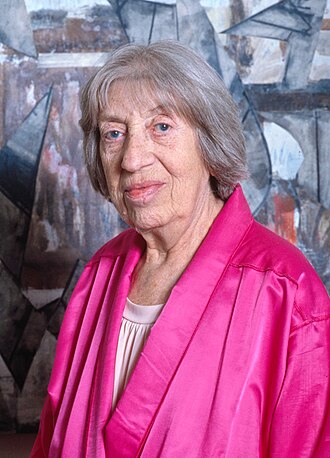 Lee Krasner