SHAWORDS

I do not literally paint that table, but the emotion it produces upon — Henri Matisse

"I do not literally paint that table, but the emotion it produces upon me." After a pause full of intense thought on my part, I asked: "But if one hasnt always emotion. What then?" "Do not paint," he quickly answered. "When I came in here to work this morning I had no emotion, so I took a horseback ride. When I returned I felt like painting, and had all the emotion I wanted."
Henri Matisse
Henri Matisse
Henri Matisse
author63 quotes

Henri Émile Benoît Matisse was a French visual artist, known for both his use of colour and his fluid and original draughtsmanship. He was a draughtsman, printmaker, and sculptor, but is known primarily as a painter.

More by Henri Matisse

View all →
Quote
"Expression for me does not reside in passions glowing in a human face or manifested by violent movement. The entire arrangement of my picture is expressive; the place occupied by my figures, the empty space around them, the proportions, everything has its share. Composition is the art of arranging in a decorative manner the diverse elements at the painters command to express his feelings. In a picture every part will be visible and will play its appointed role, whether it be principal or secondary. Everything that is not useful in the picture is, it follows, harmful. A work of art must be harmonious in its entirety: any superfluous detail would replace some other essential detail in the mind of the spectator."
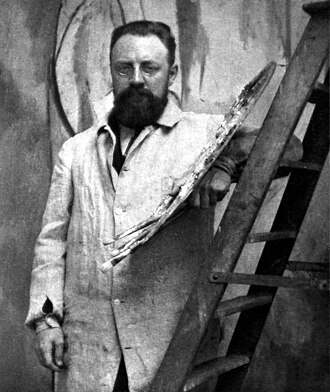
Henri MatisseHenri Matisse
Quote
"What interests me most is neither still life nor landscape but the human figure. It is through it that I best succeed in expressing the nearly religious feeling that I have towards life. I do not insist upon the details of the face. I do not care to repeat them with anatomical exactness. Though I happen to have an Italian model whose appearance at first suggests nothing but a purely animal existence, yet I succeed in picking out among the lines of his face those which suggest that deep gravity which persists in every human being."
Henri MatisseHenri Matisse

More on Pain

View all →
Quote
"The only influences in [the painting The sick Child, Munch painted in his elderly home, remembering very accurate the last days of his dying little sister Sophie] The sick Child.. ..were the ones that come from my home.. ..my childhood and my home. Only someone who knew the conditions at home could possibly understand why there can be no conceivable chance of any other place having played a part – my home is to my art as a midwife is to her children.. ..few painters have ever experienced the full grief of their subject as I did in The sick child. It was not just I who was suffering; it was all my nearest and dearest as well."
Edvard MunchEdvard Munch
Quote
"At first when I saw The Sick Child [in his imagination] her pallid face and the vivid red hair against the pillow – I saw something that vanished when I tried to paint it. I ended up with a picture on the canvas which, although I was pleased with it, bore little relationship to what I had seen.. ..In the space of that year [1885 – 1886], scratching it out, just letting the paint flow, endlessly I tried to recapture what I had seen for the first time – the pale transparent skin against the linen sheets, the trembling lips, the shaking hands. I repainted the painting numerous times – scratched it out – let it become blurred in the medium – and tried again and again to catch the first impression – the transparent pale skin against the canvas – the trembling mouth – the trembling hands. I had done the chair [in which his sister Sophie had died] with the glass too often. It distracted me from doing the head. – When I saw the picture I could only make out the glass and the surroundings. – Should I remove it completely? – No, it had the effect of giving depth and emphasis to the head. – I scared off half the background and left everything in masses – one could now see past and across the head and the glass.. .I had achieved much of that first impression, the trembling mouth – the transparent skin – the tired eyes – but the picture was not finished in its colour – it was pale grey – the picture was then heavy as lead. [Munch showed the painting on the Autumn Exhibition 18 October 1886; it was criticized severely, even by his bohemian art-friend Jager]"
Edvard MunchEdvard Munch