Quote
"We are alone, absolutely alone on this chance planet: and, amid all the forms of life that surround us, not one, excepting the dog, has made an alliance with us."
M
Maurice Maeterlinck"I know that you are looking for the Blue Bird, that is to say, the great secret of things and of happiness, so that Man may make our servitude still harder. … I do not hear the Animals... Where are they?... All this concerns them as much as us... We, the Trees, must not assume the responsibility alone for the grave measures that have become necessary... On the day when Man hears that we have done what we are about to do, there will be terrible reprisals... It is right, therefore, that our agreement should be unanimous, so that our silence may be the same..."
Maurice Polydore Marie Bernard Maeterlinck, also known as Count/Comte Maeterlinck from 1932, was a Belgian playwright, poet, and essayist who was Flemish but wrote in French. He was awarded the Nobel Prize in Literature in 1911 "in appreciation of his many-sided literary activities, and especially of his dramatic works, which are distinguished by a wealth of imagination and by a poetic fancy, whic
"We are alone, absolutely alone on this chance planet: and, amid all the forms of life that surround us, not one, excepting the dog, has made an alliance with us."
"The future is a world limited by ourselves; in it we discover only what concerns us and, sometimes, by chance, what interests those whom we love the most."
"All our knowledge merely helps us to die a more painful death than the animals that know nothing. A day will come when science will turn upon its error and no longer hesitate to shorten our woes. A day will come when it will dare and act with certainty; when life, grown wiser, will depart silently at its hour, knowing that it has reached its term."
"I knew that if I was captured by the Germans I would be shot at once, since I have always been counted as an enemy of Germany because of my play, Le Bourgmestre de Stillemonde, which dealt with the conditions in Belgium during the German Occupation of 1918."
"An act of goodness is of itself an act of happiness. No reward coming after the event can compare with the sweet reward that went with it."
"Mens weaknesses are often necessary to the purposes of life."
"Who made you glorious as the gates of heaven Beneath the keen full moon? Who bade the sun Clothe you with rainbows? Who, with living flower Of loveliest blue, spread garlands at your feet? God! let the torrents, like a shout of nations, Answer! and let the ice-plains echo, God! God! sing, ye meadow-streams, with gladsome voice! Ye pine-groves, with your soft and soul-like sounds! And they too have a voice, yon piles of snow, And in their perilous fall shall thunder, God!"
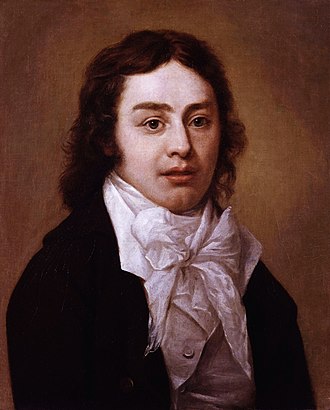 Samuel Taylor Coleridge
"Long and tedious reflection cannot enable us to shape our decisions and attitudes properly; only that definite and clear instruction which we gain can form a direct inner link to God. This instruction alone is able to give us the inner firmness and lasting peace of mind which must be regarded as the highest boon in life. And if we ascribe to God, in addition to His omnipotence and omniscience, also the attributes of goodness and love, recourse to Him produces an increased feeling of safety and happiness in the human being thirsting for solace. Against this conception not even the slightest objection can be raised from the point of natural science, for as we pointed it out before, questions of ethics are entirely outside of its realm."
"My friends, I tell you that hitherto you have been prevented from even knowing what happiness really is, solely in consequence of the errors — gross errors — that have been combined with the fundamental notions of every religion that has hitherto been taught to men. And, in consequence, they have made man the most inconsistent, and the most miserable being in existence. By the errors of these systems he has been made a weak, imbecile animal; a furious bigot and fanatic or a miserable hypocrite; and should these qualities be carried, not only into the projected villages, but into Paradise itself, a Paradise would no longer be found!"
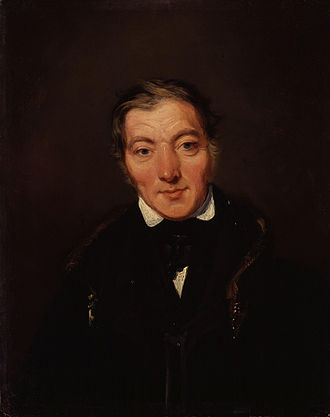 Robert Owen
"These experiences are not religious in the ordinary sense. They are natural, and can be studied naturally. They are not ineffable in the sense the sense of incommunicable by language. Maslow also came to believe that they are far commoner than one might expect, that many people tend to suppress them, to ignore them, and certain people seem actually afraid of them, as if they were somehow feminine, illogical, dangerous. One sees such attitudes more often in engineers, in mathematicians, in analytic philosophers, in book keepers and accountants, and generally in obsessional people. The tends to be a kind of bubbling-over of delight, a moment of pure happiness. For instance, a young mother scurrying around her kitchen and getting breakfast for her husband and young children. The sun was streaming in, the children clean and nicely dressed, were chattering as they ate. The husband was casually playing with the children: but as she looked at them she was suddenly so overwhelmed with their beauty and her great love for them, and her feeling of good fortune, that she went into a peak experience . . ."
"God created pain and grief for this purpose, To wit, to manifest happiness by its opposites. Hidden things are manifested by their opposites, But as God has no opposite, He remains hidden, God’s light has no opposite in the range of creation Whereby it may be manifested to view, Perforce ‘Our eyes see Him not, though He sees us,’ Behold this in the case of Moses and Mount Sinai."
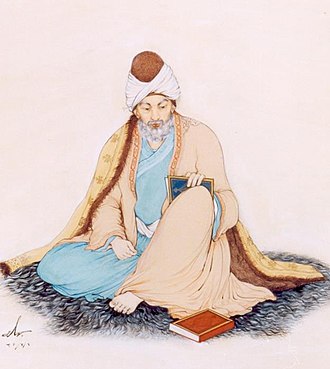 Rumi
Rumi"Let no one be slow to seek wisdom when he is young nor weary in search thereof when he is grown old. For no age is too early or too late for the health of the soul. And to say that the season for studying philosophy has not yet come, or that it is past and gone, is like saying that the season for happiness is not yet or that it is now no more."