SHAWORDS

Minds are in limited supply, and each mind has a limited capacity for — Daniel Dennett

"Minds are in limited supply, and each mind has a limited capacity for memes, and hence there is considerable competition among memes for entry in as many minds as possible. This competition is the major selective force in the memosphere, and, just as in the biosphere, the challenge has been met with great ingenuity. For instance, whatever virtues (from our perspective) the following memes have, they have in common the property of having phenotypic expressions that tend to make their own replication more likely by disabling or preempting the environmental forces that would tend to extinguish them: the meme for faith, which discourages the exercise of the sort of critical judgment that might decide that the idea of faith was, all things considered a dangerous idea; the meme for tolerance or free speech; the meme of including in a chain letter a warning about the terrible fates of those who have broken the chain in the past; the conspiracy theory meme, which has a built-in response to the objection that there is no good evidence of a conspiracy: "Of course not – thats how powerful the conspiracy is!" Some of these memes are "good" perhaps and others "bad"; what they have in common is a phenotypic effect that systematically tends to disable the selective forces arrayed against them. Other things being equal, population memetics predicts that conspiracy theory memes will persist quite independently of their truth, and the meme for faith is apt to secure its own survival, and that of the religious memes that ride piggyback on it, in even the most rationalistic environments. Indeed, the meme for faith exhibits frequency-dependent fitness: it flourishes best when it is outnumbered by rationalistic memes; in an environment with few skeptics, the meme for faith tends to fade from disuse."
Daniel Dennett
Daniel Dennett
Daniel Dennett
author77 quotes

Daniel Clement Dennett III was an American philosopher and cognitive scientist. His research centered on philosophy of mind, philosophy of science, and philosophy of biology, particularly as those fields relate to evolutionary biology and cognitive science.

More by Daniel Dennett

View all →
Quote
"We alone can be wracked with doubt, and we alone have been provoked by that epistemic itch to seek a remedy: better truth-seeking methods. Wanting to keep better track of our food supplies, our territories, our families, our enemies, we discovered the benefits of talking it over with others, asking questions, passing on lore. We invented culture. Then we invented measuring, and arithmetic, and maps, and writing. These communicative and recording innovations come with a built-in ideal: truth. The point of asking questions is to find true answers; the point of measuring is to measure accurately; the point of making maps is to find your way to your destination. … In short, the goal of truth goes without saying, in every human culture."
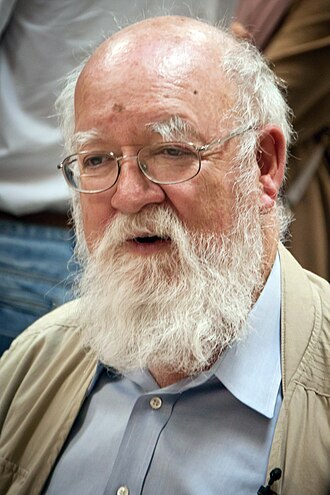
Daniel DennettDaniel Dennett
Quote
"I have grown accustomed to the disrespect expressed by some of the participants for their colleagues in the other disciplines. "Why, Dan," ask the people in artificial intelligence, "do you waste your time conferring with those neuroscientists? They wave their hands about information processing and worry about where it happens, and which neurotransmitters are involved, but they havent a clue about the computational requirements of higher cognitive functions." "Why," ask the neuroscientists, "do you waste your time on the fantasies of artificial intelligence? They just invent whatever machinery they want, and say unpardonably ignorant things about the brain." The cognitive psychologists, meanwhile, are accused of concocting models with neither biological plausibility nor proven computational powers; the anthropologists wouldnt know a model if they saw one, and the philosophers, as we all know, just take in each others laundry, warning about confusions they themselves have created, in an arena bereft of both data and empirically testable theories. With so many idiots working on the problem, no wonder consciousness is still a mystery. All these charges are true, and more besides, but I have yet to encounter any idiots. Mostly the theorists I have drawn from strike me as very smart people – even brilliant people, with the arrogance and impatience that often comes with brilliance – but with limited perspectives and agendas, trying to make progress on the hard problems by taking whatever shortcuts they can see, while deploring other peoples shortcuts. No one can keep all the problems and details clear, including me, and everyone has to mumble, guess and handwave about large parts of the problem."
Daniel DennettDaniel Dennett
Quote
"Of all the mind tools we acquire in the course of furnishing our brains from the stockpiles of culture, none are more important, of course, than words — first spoken, then written. Words make us more intelligent by making cognition easier, in the same way (many times multiplied) that beacons and landmarks make navigation in the world easier for simple creatures. Navigation in the abstract multidimensional world of ideas is simply impossible without a huge stock of movable, memorable landmarks that can be shared, criticized, recorded, and looked at from different perspectives."
Daniel DennettDaniel Dennett
Quote
"Scientists are just as vulnerable to wishful thinking, just as likely to be tempted by base motives, just as venal and gullible and forgetful as the rest of humankind. Scientists dont consider themselves to be saints; they dont even pretend to be priests (who according to tradition are supposed to do a better job than the rest of us at fighting off human temptation and frailty). Scientists take themselves to be just as weak and fallible as anybody else, but recognizing those very sources of error in themselves and in the groups to which they belong, they have devised elaborate systems to tie their own hands, forcibly preventing their frailties and prejudices from infecting their results."
Daniel DennettDaniel Dennett

More on Courage

View all →
Quote
"There is no ethical idea which it [dharma] has not stressed, put in its most ideal and imperative form, enforced by teaching, injunction, parable, artistic creation, formative examples. Truth, honour, loyalty, fidelity, courage, chastity, love, long-suffering, self-sacrifice, harmlessness, forgiveness, compassion, benevolence, beneficence are its common themes, are, in its view, the very stuff of a right human life, the essence of mans dharma. Buddhism, with its high and noble ethics, Jainism, with its austere ideal of self-conquest, Hinduism, with its magnificent examples of all sides of the Dharma, are not inferior in ethical teaching and practice to any religion or system, but rather take the highest rank and have had the strongest effective force."
E
Ethics
Quote
"Our units of temporal measurement, from seconds on up to months, are so complicated, asymmetrical and disjunctive so as to make coherent mental reckoning in time all but impossible. Indeed, had some tyrannical god contrived to enslave our minds to time, to make it all but impossible for us to escape subjection to sodden routines and unpleasant surprises, he could hardly have done better than handing down our present system. It is like a set of trapezoidal building blocks, with no vertical or horizontal surfaces, like a language in which the simplest thought demands ornate constructions, useless particles and lengthy circumlocutions. Unlike the more successful patterns of language and science, which enable us to face experience boldly or at least level-headedly, our system of temporal calculation silently and persistently encourages our terror of time. ... It is as though architects had to measure length in feet, width in meters and height in ells; as though basic instruction manuals demanded a knowledge of five different languages. It is no wonder then that we often look into our own immediate past or future, last Tuesday or a week from Sunday, with feelings of helpless confusion."
R
Robert Grudin
Quote
"We must present democracy as a force holding within itself the seeds of unlimited progress by the human race. By our actions we should make it clear that such a democracy is a means to a better way of life, together with a better understanding among nations. Tyranny inevitably must retire before the tremendous moral strength of the gospel of freedom and self-respect for the individual, but we have to recognize that these democratic principles do not flourish on empty stomachs, and that people turn to false promises of dictators because they are hopeless and anything promises something better than the miserable existence that they endure. However, material assistance alone is not sufficient. The most important thing for the world today in my opinion is a spiritual regeneration which would reestablish a feeling of good faith among men generally. Discouraged people are in sore need of the inspiration of great principles. Such leadership can be the rallying point against intolerance, against distrust, against that fatal insecurity that leads to war. It is to be hoped that the democratic nations can provide the necessary leadership."
G
George C. Marshall
Quote
"James Baker was the only leader in America who had the guts to stand up and act against Israels malignant disease: the settlements. When he was the Secretary of State, he simply informed the Israeli government that he would deduct the sums expended on the settlements from the money Israel was getting from the US. Threatened and made good on his threat. Baker thus confronted the "pro-Israeli" lobby in the US, both the Jewish and the Christian. Such courage is rare in the United States, as it is rare in Israel."
U
Uri Avnery