SHAWORDS

On an altogether higher level, intellectually and in its humanity, was — Thomas More

HomeThomas MoreQuote
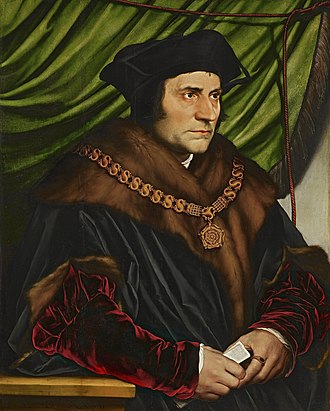
"On an altogether higher level, intellectually and in its humanity, was the work of Sir Thomas More. One of the most intriguing early portrayals of an imagined communist society is to be found in More’s Utopia, published in 1516. With this book, he gave a name to the entire genre of utopian fiction, of which several thousand examples saw the light of day over the next five hundred years. More himself eventually suffered the same fate as John Ball (and Müntzer) – he was executed, although, unlike Ball, not primarily for anything he wrote or said. In contrast also to Ball, he had risen high in English society, holding the important rank of lord chancellor. He was beheaded because he did not endorse Henry VIII’s decision to appoint himself the supreme head of the Church in England, thereby supplanting the pope. More did not openly oppose the king. He was put to death principally for opinions he did not make public, his very silence becoming a ‘political crime’. Yet More’s Utopia would, on the face of it, appear to be more subversive of the hierarchy largely taken for granted in medieval Europe than his silence over the king’s extension of his powers."
Thomas More
Thomas More
Thomas More
author26 quotes

Sir Thomas More, venerated in the Catholic Church as a martyr and saint, was an English lawyer, judge, social philosopher, author, statesman, theologian and noted Renaissance humanist. He also served Henry VIII as Lord Chancellor from October 1529 to May 1532. He wrote Utopia, published in 1516, which describes the political system of an imaginary island state.

More by Thomas More

View all →
Quote
"They have no lawyers among them, for they consider them as a sort of people whose profession it is to disguise matters and to wrest the laws, and, therefore, they think it is much better that every man should plead his own cause, and trust it to the judge, as in other places the client trusts it to a counsellor; by this means they both cut off many delays and find out truth more certainly; for after the parties have laid open the merits of the cause, without those artifices which lawyers are apt to suggest, the judge examines the whole matter, and supports the simplicity of such well-meaning persons, whom otherwise crafty men would be sure to run down; and thus they avoid those evils which appear very remarkably among all those nations that labour under a vast load of laws. Every one of them is skilled in their law; for, as it is a very short study, so the plainest meaning of which words are capable is always the sense of their laws; and they argue thus: all laws are promulgated for this end, that every man may know his duty; and, therefore, the plainest and most obvious sense of the words is that which ought to be put upon them, since a more refined exposition cannot be easily comprehended, and would only serve to make the laws become useless to the greater part of mankind, and especially to those who need most the direction of them; for it is all one not to make a law at all or to couch it in such terms that, without a quick apprehension and much study, a man cannot find out the true meaning of it, since the generality of mankind are both so dull, and so much employed in their several trades, that they have neither the leisure nor the capacity requisite for such an inquiry."
Thomas MoreThomas More
Quote
"The island of Utopia is in the middle two hundred miles broad, and holds almost at the same breadth over a great part of it, but it grows narrower towards both ends. Its figure is not unlike a crescent. Between its horns the sea comes in eleven miles broad, and spreads itself into a great bay, which is environed with land to the compass of about five hundred miles, and is well secured from winds. In this bay there is no great current; the whole coast is, as it were, one continued harbour, which gives all that live in the island great convenience for mutual commerce. But the entry into the bay, occasioned by rocks on the one hand and shallows on the other, is very dangerous. In the middle of it there is one single rock which appears above water, and may, therefore, easily be avoided; and on the top of it there is a tower, in which a garrison is kept; the other rocks lie under water, and are very dangerous. The channel is known only to the natives; so that if any stranger should enter into the bay without one of their pilots he would run great danger of shipwreck."
Thomas MoreThomas More
Quote
"Those among them that have not received our religion do not fright any from it, and use none ill that goes over to it, so that all the while I was there one man was only punished on this occasion. He being newly baptised did, notwithstanding all that we could say to the contrary, dispute publicly concerning the Christian religion, with more zeal than discretion, and with so much heat, that he not only preferred our worship to theirs, but condemned all their rites as profane, and cried out against all that adhered to them as impious and sacrilegious persons, that were to be damned to everlasting burnings. Upon his having frequently preached in this manner he was seized, and after trial he was condemned to banishment, not for having disparaged their religion, but for his inflaming the people to sedition; for this is one of their most ancient laws, that no man ought to be punished for his religion."
Thomas MoreThomas More

More on Friendship

View all →
Quote
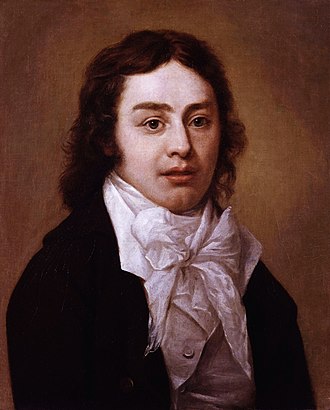
"How seldom, Friend! a good great man inherits Honour or wealth, with all his worth and pains! It sounds like stories from the land of spirits, If any man obtain that which he merits, Or any merit that which he obtains.   . For shame, dear Friend! renounce this canting strain! … Greatness and goodness are not means, but ends! Hath he not always treasures, always friends, The good great man? Three treasures, and , And , regular as infants breath; And three firm friends, more sure than day and night, , his , and the Angel ."
Samuel Taylor ColeridgeSamuel Taylor Coleridge
Quote
"Chronology, the time which changes things, makes them grow older, wears them out, and manages to dispose of them, chronologically, forever. Thank God there is kairos too: again the Greeks were wiser than we are. They had two words for time: chronos and kairos. Kairos is not measurable. Kairos is ontological. In kairos we are, we are fully in isness, not negatively, as Sartre saw the isness of the oak tree, but fully, wholly, positively. Kairos can sometimes enter, penetrate, break through : the child at play, the painter at his easel, Serkin playing the Appassionata are in kairos. The saint in prayer, friends around the dinner table, the mother reaching out her arms for her newborn baby are in kairos. The bush, the , is in kairos, not any burning bush, but the particular burning bush before which Moses removed his shoes; the bush I pass by on my way to the brook. In kairos that part of us which is not consumed in the burning is wholly awake."
O
Ontology
Quote
"Besides inventing quantum theory, Planck had made another great contribution to science by welcoming and generously supporting the young Albert Einstein. In 1905, when Einstein, then an unknown employee of the Swiss patent office in Bern, sent five revolutionary papers to the physics journal that Planck edited in Berlin, Planck immediately recognized them as works of genius and published them quickly without sending them to referees. He did not agree with all of Einstein’s ideas, but he published all of them. He helped Einstein to move ahead in the academic world, and in 1913 invited him to a full professorship in Berlin. For twenty years Planck and Einstein were friends and colleagues in Berlin, leaders of a scientific community that remained creative and vibrant, in spite of the political and economic disarray that surrounded them. Planck was the rock-solid central figure of German science, with the vision to promote the unorthodox and unpatriotic citizen-of-the-world Einstein."
M
Max Planck