SHAWORDS

Since September 11, 2001, I have often thought that perhaps it was for — Daniel Dennett

"Since September 11, 2001, I have often thought that perhaps it was fortunate for the world that the attackers targeted the World Trade Center instead of the Statue of Liberty, for if they had destroyed our sacred symbol of democracy I fear we as Americans would have been unable to keep ourselves from indulging in paroxysms of revenge of a sort the world has never seen before. If that had happened, it would have befouled the meaning of the Statue of Liberty beyond any hope of subsequent redemption — if there were any people left to care. I have learned from my students that this upsetting thought of mine is subject to several unfortunate misconstruals, so let me expand on it to ward them off. The killing of thousands of innocents in the World Trade Center was a heinous crime, much more evil than the destruction of the Statue of Liberty would have been. And, yes, the World Trade Center was a much more appropriate symbol of al Qaedas wrath than the Statue of Liberty would have been, but for that very reason it didnt mean as much, as a symbol, to us. It was Mammon and Plutocrats and Globalization, not Lady Liberty. I do suspect that the fury with which Americans would have responded to the unspeakable defilement of our cherished national symbol, the purest image of our aspirations as a democracy, would have made a sane and measured response extraordinarily difficult. This is the great danger of symbols — they can become too "sacred". An important task for religious people of all faiths in the twenty-first century will be spreading the conviction that there are no acts more dishonorable than harming "infidels" of one stripe or another for "disrespecting" a flag, a cross, a holy text."
Daniel Dennett
Daniel Dennett
Daniel Dennett
author77 quotes

Daniel Clement Dennett III was an American philosopher and cognitive scientist. His research centered on philosophy of mind, philosophy of science, and philosophy of biology, particularly as those fields relate to evolutionary biology and cognitive science.

More by Daniel Dennett

View all →
Quote
"We alone can be wracked with doubt, and we alone have been provoked by that epistemic itch to seek a remedy: better truth-seeking methods. Wanting to keep better track of our food supplies, our territories, our families, our enemies, we discovered the benefits of talking it over with others, asking questions, passing on lore. We invented culture. Then we invented measuring, and arithmetic, and maps, and writing. These communicative and recording innovations come with a built-in ideal: truth. The point of asking questions is to find true answers; the point of measuring is to measure accurately; the point of making maps is to find your way to your destination. … In short, the goal of truth goes without saying, in every human culture."
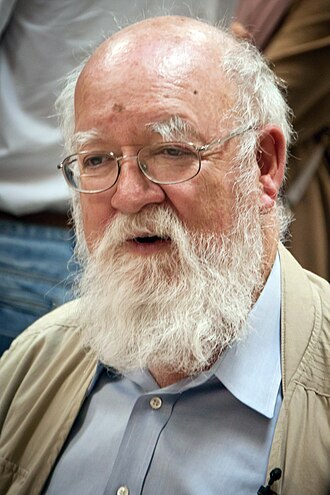
Daniel DennettDaniel Dennett
Quote
"I have grown accustomed to the disrespect expressed by some of the participants for their colleagues in the other disciplines. "Why, Dan," ask the people in artificial intelligence, "do you waste your time conferring with those neuroscientists? They wave their hands about information processing and worry about where it happens, and which neurotransmitters are involved, but they havent a clue about the computational requirements of higher cognitive functions." "Why," ask the neuroscientists, "do you waste your time on the fantasies of artificial intelligence? They just invent whatever machinery they want, and say unpardonably ignorant things about the brain." The cognitive psychologists, meanwhile, are accused of concocting models with neither biological plausibility nor proven computational powers; the anthropologists wouldnt know a model if they saw one, and the philosophers, as we all know, just take in each others laundry, warning about confusions they themselves have created, in an arena bereft of both data and empirically testable theories. With so many idiots working on the problem, no wonder consciousness is still a mystery. All these charges are true, and more besides, but I have yet to encounter any idiots. Mostly the theorists I have drawn from strike me as very smart people – even brilliant people, with the arrogance and impatience that often comes with brilliance – but with limited perspectives and agendas, trying to make progress on the hard problems by taking whatever shortcuts they can see, while deploring other peoples shortcuts. No one can keep all the problems and details clear, including me, and everyone has to mumble, guess and handwave about large parts of the problem."
Daniel DennettDaniel Dennett
Quote
"Of all the mind tools we acquire in the course of furnishing our brains from the stockpiles of culture, none are more important, of course, than words — first spoken, then written. Words make us more intelligent by making cognition easier, in the same way (many times multiplied) that beacons and landmarks make navigation in the world easier for simple creatures. Navigation in the abstract multidimensional world of ideas is simply impossible without a huge stock of movable, memorable landmarks that can be shared, criticized, recorded, and looked at from different perspectives."
Daniel DennettDaniel Dennett
Quote
"Scientists are just as vulnerable to wishful thinking, just as likely to be tempted by base motives, just as venal and gullible and forgetful as the rest of humankind. Scientists dont consider themselves to be saints; they dont even pretend to be priests (who according to tradition are supposed to do a better job than the rest of us at fighting off human temptation and frailty). Scientists take themselves to be just as weak and fallible as anybody else, but recognizing those very sources of error in themselves and in the groups to which they belong, they have devised elaborate systems to tie their own hands, forcibly preventing their frailties and prejudices from infecting their results."
Daniel DennettDaniel Dennett

More on Time

View all →
Quote
"History is a strange experience. The world is quite small now; but history is large and deep. Sometimes you can go much farther by sitting in your own home and reading a book of history, than by getting onto a ship or an airplane and traveling a thousand miles. When you go to Mexico City through space, you find it a sort of cross between modern Madrid and modern Chicago, with additions of its own; but if you go to Mexico City through history, back only 500 years, you will find it as distant as though it were on another planet: inhabited by cultivated barbarians, sensitive and cruel, highly organized and still in the Copper Age, a collection of startling, of unbelievable contrasts."
G
Gilbert Highet
Quote
"As soon as a thought or word becomes a tool, one can dispense with actually ‘thinking’ it, that is, with going through the logical acts involved in verbal formulation of it. As has been pointed out, often and correctly, the advantage of mathematics—the model of all neo-positivistic thinking—lies in just this ‘intellectual economy.’ Complicated logical operations are carried out without actual performance of the intellectual acts upon which the mathematical and logical symbols are based. … Reason … becomes a fetish, a magic entity that is accepted rather than intellectually experienced."
M
Mathematics