SHAWORDS

Superman is invincible, and Superman is the first super-being to come — Superman

HomeSupermanQuote
"Superman is invincible, and Superman is the first super-being to come into literary life. There he is alone. Thats the way I see him. If I were a Superman among two billion people, despite the fact that I was a super-being, Id feel pretty insecure. For instance, say I was a white hunter in Africa and I were to walk into a cannibal village. Despite the fact that I had a gun and they didnt, despite the fact that I had ammunition and they didnt, Id feel pretty insecure, despite the fact that I could probably shoot my way out. Superman is alone in our world."
Superman
Superman
Superman
author56 quotes

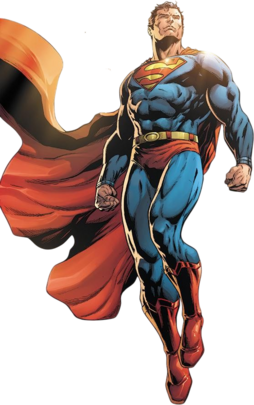
Superman is a superhero created by writer Jerry Siegel and artist Joe Shuster, first appearing in issue #1 of Action Comics, published in the United States on April 18, 1938. Superman has been regularly published in American comic books published by DC Comics since then, and has been adapted to other media including radio serials, novels, films, television shows, theater, and video games. Superman

More by Superman

View all →
Quote
"Villains are really what give comic stories their flavor. Honestly, I think Superman would be quite dull without a really great villain. Batman, maybe not so much, because hes such a twisted character himself. Hes struggling with a lot of inner demons. But Superman is the kind of guy whos impossible to hate, because hes a guys guy, and hes straightforward. He can be a little sarcastic and he has a wryness about him. But he doesnt have a lot of dark corners. So I think that contrasting him with someone like Darkseid, whos a real badass villain, absolutely makes the script more interesting."
SupermanSuperman
Quote
"I didnt bother getting into it with Tarantino about the Superman thing, because its not really true," chuckles Carradine. "Its not unique. The idea that Supermans analysis, whatever you want to call it, his image of the human race is Clark Kent, weak, a coward, fumbling, wearing glasses, uncertain of himself, not able to get a girl, all those kinds of things. Thats his idea about us and thats the point that Tarantino was trying to make. But the idea of Superman being unique in that he was born Superman, which is another point that Tarantinos trying to make, that thats what these people [Bill, etc.] are, these people are born warriors and they cant help it, but theres also the Silver Surfer, right? And theres Sub-Mariner..."
SupermanSuperman
Quote
"Superman has always defended vulnerable communities and he’s always been political, says Joseph Darowski, a professor at Brigham Young University. Darowski is also a comic historian and the editor of “The Ages of Superman: Essays on the Man of Steel in Changing Times.” “It’s an inevitable part of the comic book industry that politics is going to seep in,” Darowski says. “There’s always some reflection of what’s going on on the world stage.” In the 1940s, Superman tried to stop World War II. He’s taken on corrupt politicians and got political during the Cold War, too. “As America gets engaged in the space race, suddenly Superman’s enemies are coming from the stars more frequently,” Darowski says. “Kryptonite and other forms of radiation creeps into the stories after the dropping of the atomic bomb. During the Cold War and the nuclear arms race, Kryptonite becomes much more commonly used in Super-man stories, and villains who get their power through radiation also become much more common. These geopolitical events end up being adapted in fantastic ways into the Superman comics.”"
SupermanSuperman

More on Life

View all →
Quote
"If it fulfills our hopes, this center will be, at once, a symbol and a reflection and a hope. It will symbolize our belief that the world of creation and thought are at the core of all civilization. Only recently in the White House we helped commemorate the 400th anniversary of Shakespeare. The political conflicts and ambitions of his England are known to the scholar and to the specialist. But his plays will forever move men in every corner of the world. The leaders that he wrote about live far more vividly in his words than in the almost forgotten facts of their own rule. Our civilization, too, will largely survive in the works of our creation. There is a quality in art which speaks across the gulf dividing man from man and nation from nation, and century from century. That quality confirms the faith that our common hopes may be more enduring than our conflicting hostilities. Even now men of affairs are struggling to catch up with the insights of great art. The stakes may well be the survival of civilization. The personal preferences of men in government are not important--except to themselves. However, it is important to know that the opportunity we give to the arts is a measure of the quality of our civilization. It is important to be aware that artistic activity can enrich the life of our people, which really is the central object of Government. It is important that our material prosperity liberate and not confine the creative spirit."
L
Lyndon B. Johnson
Quote
"I did not go to join Kurtz there and then. I did not. I remained to dream the nightmare out to the end, and to show my loyalty to Kurtz once more. Destiny. My destiny! Droll thing life is — that mysterious arrangement of merciless logic for a futile purpose. The most you can hope from it is some knowledge of yourself — that comes too late — a crop of unextinguishable regrets. I have wrestled with death. It is the most unexciting contest you can imagine. It takes place in an impalpable grayness, with nothing underfoot, with nothing around, without spectators, without clamor, without glory, without the great desire of victory, without the great fear of defeat, in a sickly atmosphere of tepid skepticism, without much belief in your own right, and still less in that of your adversary. If such is the form of ultimate wisdom, then life is a greater riddle than some of us think it to be. I was within a hairs-breadth of the last opportunity for pronouncement, and I found with humiliation that probably I would have nothing to say. This is the reason why I affirm that Kurtz was a remarkable man. He had something to say. He said it. Since I had peeped over the edge myself, I understand better the meaning of his stare, that could not see the flame of the candle, but was wide enough to embrace the whole universe, piercing enough to penetrate all the hearts that beat in the darkness. He had summed up — he had judged. The horror! He was a remarkable man. After all, this was the expression of some sort of belief; it had candor, it had conviction, it had a vibrating note of revolt in its whisper, it had the appalling face of a glimpsed truth — the strange commingling of desire and hate."
H
Heart of Darkness