SHAWORDS

The disagreement between Dan and myself is essentially this. Were livi — Daniel Dennett

"The disagreement between Dan and myself is essentially this. Were living in a world where most people believe in Atlantis and they believe in the underwater kingdom and they read Plato closely, trying to figure out where it was. And I want to say Atlantis doesnt exist, it didnt exist, people are confused about Atlantis. Dan wants to say that Atlantis is really Sicily, and hell give a whole argument about why Sicily answers to many of the claims that people are making about Atlantis. And I want to say, "No, theyre still talking about being underwater. Sicily doesnt do that." And he says, "But Sicily is a great place and theres reasons to visit, and lets talk about Sicily." And when he and I argue about this, he begins to respond to me as though Im saying Sicily doesnt exist. And so theres a fair amount of talking past one another in these kinds of debates. Of course Sicily exists, but the people who are talking about an underwater kingdom are, at the very least, confused, and thats the situation were in with free will."
Daniel Dennett
Daniel Dennett
Daniel Dennett
author77 quotes

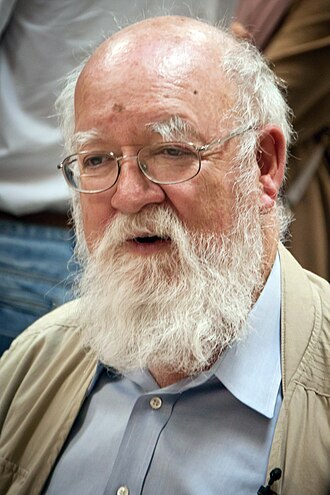
Daniel Clement Dennett III was an American philosopher and cognitive scientist. His research centered on philosophy of mind, philosophy of science, and philosophy of biology, particularly as those fields relate to evolutionary biology and cognitive science.

More by Daniel Dennett

View all →
Quote
"We alone can be wracked with doubt, and we alone have been provoked by that epistemic itch to seek a remedy: better truth-seeking methods. Wanting to keep better track of our food supplies, our territories, our families, our enemies, we discovered the benefits of talking it over with others, asking questions, passing on lore. We invented culture. Then we invented measuring, and arithmetic, and maps, and writing. These communicative and recording innovations come with a built-in ideal: truth. The point of asking questions is to find true answers; the point of measuring is to measure accurately; the point of making maps is to find your way to your destination. … In short, the goal of truth goes without saying, in every human culture."
Daniel DennettDaniel Dennett
Quote
"I have grown accustomed to the disrespect expressed by some of the participants for their colleagues in the other disciplines. "Why, Dan," ask the people in artificial intelligence, "do you waste your time conferring with those neuroscientists? They wave their hands about information processing and worry about where it happens, and which neurotransmitters are involved, but they havent a clue about the computational requirements of higher cognitive functions." "Why," ask the neuroscientists, "do you waste your time on the fantasies of artificial intelligence? They just invent whatever machinery they want, and say unpardonably ignorant things about the brain." The cognitive psychologists, meanwhile, are accused of concocting models with neither biological plausibility nor proven computational powers; the anthropologists wouldnt know a model if they saw one, and the philosophers, as we all know, just take in each others laundry, warning about confusions they themselves have created, in an arena bereft of both data and empirically testable theories. With so many idiots working on the problem, no wonder consciousness is still a mystery. All these charges are true, and more besides, but I have yet to encounter any idiots. Mostly the theorists I have drawn from strike me as very smart people – even brilliant people, with the arrogance and impatience that often comes with brilliance – but with limited perspectives and agendas, trying to make progress on the hard problems by taking whatever shortcuts they can see, while deploring other peoples shortcuts. No one can keep all the problems and details clear, including me, and everyone has to mumble, guess and handwave about large parts of the problem."
Daniel DennettDaniel Dennett
Quote
"Of all the mind tools we acquire in the course of furnishing our brains from the stockpiles of culture, none are more important, of course, than words — first spoken, then written. Words make us more intelligent by making cognition easier, in the same way (many times multiplied) that beacons and landmarks make navigation in the world easier for simple creatures. Navigation in the abstract multidimensional world of ideas is simply impossible without a huge stock of movable, memorable landmarks that can be shared, criticized, recorded, and looked at from different perspectives."
Daniel DennettDaniel Dennett
Quote
"Scientists are just as vulnerable to wishful thinking, just as likely to be tempted by base motives, just as venal and gullible and forgetful as the rest of humankind. Scientists dont consider themselves to be saints; they dont even pretend to be priests (who according to tradition are supposed to do a better job than the rest of us at fighting off human temptation and frailty). Scientists take themselves to be just as weak and fallible as anybody else, but recognizing those very sources of error in themselves and in the groups to which they belong, they have devised elaborate systems to tie their own hands, forcibly preventing their frailties and prejudices from infecting their results."
Daniel DennettDaniel Dennett

More on People

View all →
Quote
"I should say that when people talk about capitalism its a bit of a joke. Theres no such thing. No country, no business class, has ever been willing to subject itself to the free market, free market discipline. Free markets are for others. Like, the Third World is the Third World because they had free markets rammed down their throat. Meanwhile, the enlightened states, England, the United States, others, resorted to massive state intervention to protect private power, and still do. Thats right up to the present. I mean, the Reagan administration for example was the most protectionist in post-war American history. Virtually the entire dynamic economy in the United States is based crucially on state initiative and intervention: computers, the internet, telecommunication, automation, pharmaceutical, you just name it. Run through it, and you find massive ripoffs of the public, meaning, a system in which under one guise or another the public pays the costs and takes the risks, and profit is privatized. Thats very remote from a free market. Free market is like what India had to suffer for a couple hundred years, and most of the rest of the Third World."
N
Noam Chomsky