SHAWORDS

The relationship between commitment and doubt is by no means an antago — Rollo May

HomeRollo MayQuote
"The relationship between commitment and doubt is by no means an antagonistic one. Commitment is healthiest when it is not without doubt but in spite of doubt."
R
Rollo May
Rollo May
author112 quotes

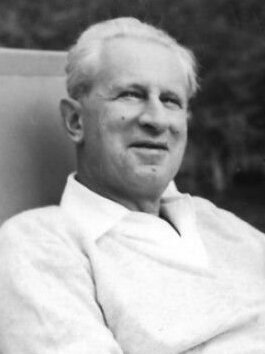
Rollo Reece May was an American existential psychologist and author of the influential book Love and Will (1969). He is often associated with humanistic psychology and existentialist philosophy, and alongside Viktor Frankl, was a major proponent of existential psychotherapy. The philosopher and theologian Paul Tillich was a close friend who had a significant influence on his work.

More by Rollo May

View all →
Quote
"My fellow liberals and I in America, and in Europe to a lesser extent, believed so strongly in peace and world brotherhood in those days that we could not even see Hitler or the destructively daimonic reality he represented. Human beings just couldnt be that cruel in the our civilized twentieth century — the accounts in the papers must be wrong. Our error was that we let our convictions limit our perceptions. We had no place for the daimonic; we believed that the world must somehow fit our convictions, and the whole daimonic dimension was ruled out of our perception. Not to recognize the daimonic itself turns out to be daimonic, it makes us accomplices on the side of the destructive possession. The denial of the daimonic is, in effect, a self-castration in love and a self-nullification in will. And the denial leads to the perverted forms of aggression we have seen in our day in which the repressed comes back to haunt us."
R
Rollo May
Quote
"In any age courage is the simple virtue needed for a human being to traverse the rocky road from infancy to maturity of personality. But in an age of anxiety, an age of her morality and personal isolation, courage is a sine qua non. In periods when the mores of the society were more consistent guides, the individual was more firmly cushioned in his crises of development; but in times of transition like ours, the individual is thrown on his own at an earlier age and for a longer period."
R
Rollo May
Quote
"I must make the important distinction between the rebel and the revolutionary. One is in ineradicable opposition to the other. The revolutionary seeks an external political change, "the overthrow or renunciation of one government or ruler and the substitution of another." The origin of the term is the word revolve, literally meaning a turnover, as the revolution of a wheel. When the conditions under a given government are insufferable some groups may seek to break down that government in the conviction that any new form cannot but be better. Many revolutions, however, simply substitute one kind of government for another, the second no better than the first — which leaves the individual citizen, who has had to endure the inevitable anarchy between the two, worse off than before. Revolution may do more harm than good. The rebel, on the other hand, is "one who opposes authority or restraint: one who breaks with established custom or tradition." … He seeks above all an internal change, a change in the attitudes, emotions, and outlook of the people to whom he is devoted. He often seems to be temperamentally unable to accept success and the ease it brings; he kicks against the pricks, and when one frontier is conquered, he soon becomes ill-at-ease and pushes on to the new frontier. He is drawn to the unquiet minds and spirits, for he shares their everlasting inability to accept stultifying control. He may, as Socrates did, refer to himself as the gadfly for the state — the one who keeps the state from settling down into a complacency, which is the first step toward decadance. No matter how much the rebel gives the appearance of being egocentric or of being on an "ego trip," this is a delusion; inwardly the authentic rebel is anything but brash."
R
Rollo May

More on Relationship

View all →
Quote
"Overtly, I had so-called normal relationships with a number of terrestrial women having pumpkins or pears for breasts; inly, I was consumed by a hell furnace of localized lust for every passing nymphet whom as a law-abiding poltroon I never dared approach. The human females I was allowed to wield were but palliative agents. I am ready to believe that the sensations I derived from natural fornication were much the same as those known to normal big males consorting with their normal big mates in that routine rhythm which shakes the world. The trouble was that those gentlemen had not, and I had, caught glimpses of an incomparably more poignant bliss. The dimmest of my pollutive dreams was a thousand times more dazzling than all the adultery the most virile writer of genius or the most talented impotent might imagine."
LolitaLolita
Quote
"At first when I saw The Sick Child [in his imagination] her pallid face and the vivid red hair against the pillow – I saw something that vanished when I tried to paint it. I ended up with a picture on the canvas which, although I was pleased with it, bore little relationship to what I had seen.. ..In the space of that year [1885 – 1886], scratching it out, just letting the paint flow, endlessly I tried to recapture what I had seen for the first time – the pale transparent skin against the linen sheets, the trembling lips, the shaking hands. I repainted the painting numerous times – scratched it out – let it become blurred in the medium – and tried again and again to catch the first impression – the transparent pale skin against the canvas – the trembling mouth – the trembling hands. I had done the chair [in which his sister Sophie had died] with the glass too often. It distracted me from doing the head. – When I saw the picture I could only make out the glass and the surroundings. – Should I remove it completely? – No, it had the effect of giving depth and emphasis to the head. – I scared off half the background and left everything in masses – one could now see past and across the head and the glass.. .I had achieved much of that first impression, the trembling mouth – the transparent skin – the tired eyes – but the picture was not finished in its colour – it was pale grey – the picture was then heavy as lead. [Munch showed the painting on the Autumn Exhibition 18 October 1886; it was criticized severely, even by his bohemian art-friend Jager]"
Edvard MunchEdvard Munch
Quote
"This Conference:... (3) recognises that there are among us persons who experience themselves as having a homosexual orientation. Many of these are members of the Church and are seeking the pastoral care, moral direction of the Church, and Gods transforming power for the living of their lives and the ordering of relationships. We commit ourselves to listen to the experience of homosexual persons and we wish to assure them that they are loved by God and that all baptised, believing and faithful persons, regardless of sexual orientation, are full members of the Body of Christ; (4) while rejecting homosexual practice as incompatible with Scripture, calls on all our people to minister pastorally and sensitively to all irrespective of sexual orientation and to condemn irrational fear of homosexuals"
P
Peter Akinola
Quote
"These effects of mescalin are the sort of effects you could expect to follow the administration of a drug having the power to impair the efficiency of the cerebral reducing valve. When the brain runs out of sugar, the undernourished ego grows weak, cant be bothered to undertake the necessary chores, and loses all interest in those spatial and temporal relationships which mean so much to an organism bent on getting on in the world. As Mind at Large seeps past the no longer watertight valve, all kinds of biologically useless things start to happen. ... Other persons discover a world of visionary beauty. To others again is revealed the glory, the infinite value and meaningfulness of naked existence, of the given, unconceptualized event."
A
Aldous Huxley