SHAWORDS

There is no gift like the gift of the Dhamma, (no acquaintance like) a — Ashoka

HomeAshokaQuote
"There is no gift like the gift of the Dhamma, (no acquaintance like) acquaintance with Dhamma, (no distribution like) distribution of Dhamma, and (no kinship like) kinship through Dhamma. And it consists of this: proper behavior towards servants and employees, respect for mother and father, generosity to friends, companions, relations, Brahmans and ascetics, and not killing living beings. Therefore a father, a son, a brother, a master, a friend, a companion or a neighbor should say: "This is good, this should be done." One benefits in this world and gains great merit in the next by giving the gift of the Dhamma."
Ashoka
Ashoka
Ashoka
author20 quotes

Ashoka, also known as Asoka or Aśoka, most commonly known as Ashoka the Great, was Emperor of Magadha from c. 268 BCE until his death, and the third ruler from the Mauryan dynasty. His empire covered a large part of the Indian subcontinent, stretching from present-day Afghanistan in the west to present-day Bangladesh in the east, with its capital at Pataliputra. A patron of Buddhism, he is credite

More by Ashoka

View all →
Quote
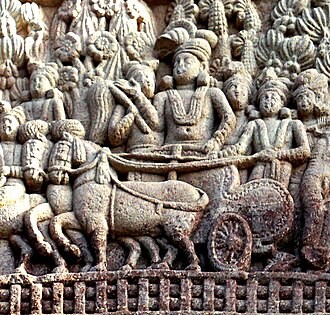
"Beloved-of-the-Gods, King Piyadasi, has caused this Dhamma edict to be written. Here (in my domain) no living beings are to be slaughtered or offered in sacrifice. Formerly, in the kitchen of Beloved-of-the-Gods, King Piyadasi, hundreds of thousands of animals were killed every day to make curry. But now with the writing of this Dhamma edict only three creatures, two peacocks and a deer are killed, and the deer not always. And in time, not even these three creatures will be killed."
AshokaAshoka
Quote
"Everywhere within Beloved-of-the-Gods, King Piyadasis domain, and among the people beyond the borders, the Cholas, the Pandyas, the Satiyaputras, the Keralaputras, as far as Tamraparni and where the Greek king Antiochos rules, and among the kings who are neighbours of Antiochos, everywhere has Beloved-of-the-Gods, King Piyadasi, made provision for two types of medical treatment: medical treatment for humans and medical treatment for animals. Wherever medical herbs suitable for humans or animals are not available, I have had them imported and grown. Wherever medical roots or fruits are not available I have had them imported and grown. Along roads I have had wells dug and trees planted for the benefit of humans and animals."
AshokaAshoka

More on Friendship

View all →
Quote
"How seldom, Friend! a good great man inherits Honour or wealth, with all his worth and pains! It sounds like stories from the land of spirits, If any man obtain that which he merits, Or any merit that which he obtains.   . For shame, dear Friend! renounce this canting strain! … Greatness and goodness are not means, but ends! Hath he not always treasures, always friends, The good great man? Three treasures, and , And , regular as infants breath; And three firm friends, more sure than day and night, , his , and the Angel ."
Samuel Taylor ColeridgeSamuel Taylor Coleridge
Quote
"Chronology, the time which changes things, makes them grow older, wears them out, and manages to dispose of them, chronologically, forever. Thank God there is kairos too: again the Greeks were wiser than we are. They had two words for time: chronos and kairos. Kairos is not measurable. Kairos is ontological. In kairos we are, we are fully in isness, not negatively, as Sartre saw the isness of the oak tree, but fully, wholly, positively. Kairos can sometimes enter, penetrate, break through : the child at play, the painter at his easel, Serkin playing the Appassionata are in kairos. The saint in prayer, friends around the dinner table, the mother reaching out her arms for her newborn baby are in kairos. The bush, the , is in kairos, not any burning bush, but the particular burning bush before which Moses removed his shoes; the bush I pass by on my way to the brook. In kairos that part of us which is not consumed in the burning is wholly awake."
O
Ontology
Quote
"Besides inventing quantum theory, Planck had made another great contribution to science by welcoming and generously supporting the young Albert Einstein. In 1905, when Einstein, then an unknown employee of the Swiss patent office in Bern, sent five revolutionary papers to the physics journal that Planck edited in Berlin, Planck immediately recognized them as works of genius and published them quickly without sending them to referees. He did not agree with all of Einstein’s ideas, but he published all of them. He helped Einstein to move ahead in the academic world, and in 1913 invited him to a full professorship in Berlin. For twenty years Planck and Einstein were friends and colleagues in Berlin, leaders of a scientific community that remained creative and vibrant, in spite of the political and economic disarray that surrounded them. Planck was the rock-solid central figure of German science, with the vision to promote the unorthodox and unpatriotic citizen-of-the-world Einstein."
M
Max Planck