Quote
"In order for a war to be just, three things are necessary. First, the authority of the sovereign…. Secondly, a just cause…. Thirdly … a rightful intention."
J
Just war theory"War, in one form or another, appeared with the first man. At the dawn of history, its morality was not questioned; it was simply a fact, like drought or disease -- the manner in which tribes and then civilizations sought power and settled their differences. And over time, as codes of law sought to control violence within groups, so did philosophers and clerics and statesmen seek to regulate the destructive power of war. The concept of a "just war" emerged, suggesting that war is justified only when certain conditions were met: if it is waged as a last resort or in self-defense; if the force used is proportional; and if, whenever possible, civilians are spared from violence. Of course, we know that for most of history, this concept of "just war" was rarely observed. The capacity of human beings to think up new ways to kill one another proved inexhaustible, as did our capacity to exempt from mercy those who look different or pray to a different God."
The just war theory is a doctrine, also referred to as a tradition, of military ethics that aims to ensure that a war is morally justifiable through a series of criteria, all of which must be met for a war to be considered just. It has been studied by military leaders, theologians, ethicists and policymakers. The criteria are split into two groups: jus ad bellum and jus in bello. There have been c
"In order for a war to be just, three things are necessary. First, the authority of the sovereign…. Secondly, a just cause…. Thirdly … a rightful intention."
"Modern civilization has introduced great qualifications to soften the rigours of war; and allows a degree of intercourse with enemies, and particularly with prisoners of war, which can hardly be carried on without the assistance of our Courts of justice. It is not therefore good policy to encourage these strict notions, which are insisted on contrary to morality and public convenience."
"When people ask me what I did in the war, I tell them I did the same thing we all did. We fought for what was right. Ive come to realize, theres nothing good about war... But there is good in why you fight wars. And we were all fighting for the same thing."
"Justa bella quibus necessaria."
"The war in Afghanistan against apocalyptic terrorism qualifies in my understanding as the first truly just war since World War II."
"They who have waged war in obedience to the divine command, or in conformity with His laws, have represented in their persons the public justice or the wisdom of government, and in this capacity have put to death wicked men; such persons have by no means violated the commandment, "Thou shalt not kill."
"If it fulfills our hopes, this center will be, at once, a symbol and a reflection and a hope. It will symbolize our belief that the world of creation and thought are at the core of all civilization. Only recently in the White House we helped commemorate the 400th anniversary of Shakespeare. The political conflicts and ambitions of his England are known to the scholar and to the specialist. But his plays will forever move men in every corner of the world. The leaders that he wrote about live far more vividly in his words than in the almost forgotten facts of their own rule. Our civilization, too, will largely survive in the works of our creation. There is a quality in art which speaks across the gulf dividing man from man and nation from nation, and century from century. That quality confirms the faith that our common hopes may be more enduring than our conflicting hostilities. Even now men of affairs are struggling to catch up with the insights of great art. The stakes may well be the survival of civilization. The personal preferences of men in government are not important--except to themselves. However, it is important to know that the opportunity we give to the arts is a measure of the quality of our civilization. It is important to be aware that artistic activity can enrich the life of our people, which really is the central object of Government. It is important that our material prosperity liberate and not confine the creative spirit."
"The fundamental core of contemporary Darwinism, the theory of DNA-based reproduction and evolution, is now beyond dispute among scientists. It demonstrates its power every day, contributing crucially to the explanation of planet-sized facts of geology and meteorology, through middle-sized facts of ecology and agronomy, down to the latest microscopic facts of genetic engineering. It unifies all of biology and the history of our planet into a single grand story. Like Gulliver tied down in Lilliput, it is unbudgable, not because of some one or two huge chains of argument that might — hope against hope — have weak links in them, but because it is securely tied by thousands of threads of evidence anchoring it to virtually every other area of human knowledge. New discoveries may conceivably lead to dramatic, even "revolutionary" shifts in the Darwinian theory, but the hope that it will be "refuted" by some shattering breakthrough is about as reasonable as the hope that we will return to a geocentric vision and discard Copernicus."
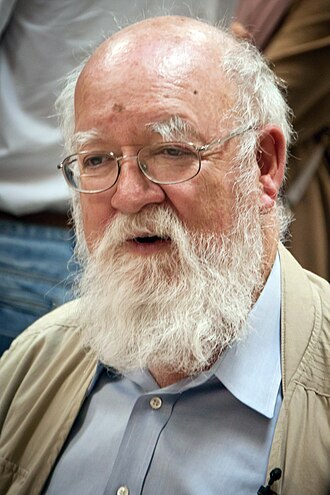 Daniel Dennett
"An authorship that began with Either/Or and advanced step by step seeks here its decisive place of rest, at the foot of the altar, where the author, personally most aware of his own imperfections and guilt, certainly does not call himself a truth-witness but only a singular kind of poet and thinker who, without authority, has had nothing new to bring but “has wanted once again to read through, if possible in a more inward way, the original text handed down from the fathers” Preface P. 165"
"If the proverbial man of the planet Mars would come to this earth and inquire about the difference between "leader" and "ruler" he would learn that "rulers" are strange people who dressed in ermine, wore crowns, married foreign women, kept strictly to themselves, and had the inclination to administer the country without asking the people about their wishes. A "leader," on the other hand, he would be told, is a regular fellow in a simple uniform who embodies his nation, who tries desperately to create by propaganda complete unison between his ideas and the people. A leader, he might hear, was a local boy who made good, who spoke everybodys language, who never traveled abroad and disliked titles and royal paraphernalia."
 Leadership
"I went into my own black-out period [1942-45] which lasted two or three years where the canvases would simply build up until they’d get like stone and it was always just a gray mess. The image wouldn’t emerge, but I worked pretty regularly. I was fighting to find I knew not what, but I could no longer stay with what I had."
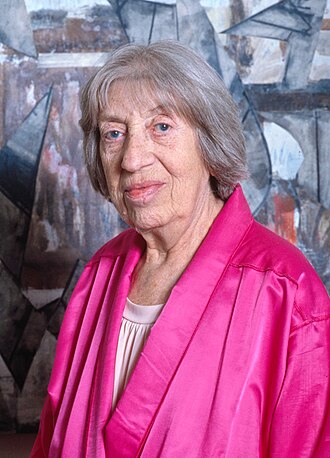 Lee Krasner
"Now, six years ago, al-Qaeda was planning to attack the Twin Towers. It wasnt a very nice world. And I think that if you think about six years ago, al-Qaida was preparing to attack the Twin Towers, Pakistan was allied with the Taliban, Afghanistan was the base from which al-Qaida was going to operate; the Israelis and the Palestinians had given up on a chance for -- or let me put it, the Palestinians had walked away from a chance for a Palestinian state, launched the second intifada, elected Ariel Sharon who basically said there would never be a Palestinian state and there will be a greater Israel; the North Korean were cheating on a deal that they had just signed; China and others were indifferent to that because it was a U.S.-North Korea bilateral deal; Iran was cheating on the IAEA out of sight. I could go on and on and on. That was the world in 2000 and 2001. And there is no doubt that by confronting -- oh, by the way, and Saddam Hussein was shooting at our pilots regularly in the no-fly zone and making a mockery of the Oil-for-Peace -- Oil-for-Food program and corruption was running rampant in that program. So, a worse world? I think so."