Quote
"To see Good Tennis! What divine joy Can fill our leisure, or our minds employ? Let other people play at other things; The King of Games is still the Game of Kings."
 Tennis
Tennis
Tennis
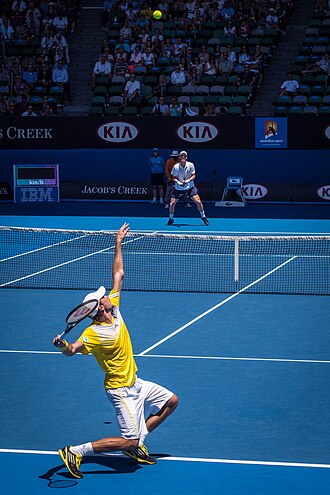
Tennis is a racket sport that is played either individually against a single opponent (singles) or between two teams of two players each (doubles). Each player uses a tennis racket strung with a cord to strike a hollow rubber ball covered with felt over or around a net and into the opponent's court. The object is to manoeuvre the ball in such a way that the opponent is not able to play a valid ret
"To see Good Tennis! What divine joy Can fill our leisure, or our minds employ? Let other people play at other things; The King of Games is still the Game of Kings."
Tennis"I honestly dont understand it, because its somebody hitting a ball to where you cant get it, but you want to get it. I think they should rethink it."
Tennis"With the waning of its popularity in fashionable circles, lawn tennis was saved by two developments. It became popular in the new suburbs and it spread like wildfire internationally. Women were increasingly interested in the game and beginning to play it seriously. This met with opposition from those who (unlike Maud Watsons father) felt that while it might be permissible for women and girls to play in the privacy of the country house park or the suburban vicarage garden, it was indecent for them to play in public. The Irish nevertheless introduced a womens event in Dublin in 1879 and in 1884 Wimbledon followed suit. There, at the age of nineteen, Maud Watson defeated her sister to win the inaugural championship. Tennis did not remain for long exclusive to Britain. The circumstances favouring its success were also present in France, and indeed across Europe and in the United States and Australia. France was in the grip of Anglomania at the end of the nineteenth century and the new game was soon all over the country, but especially on the Riviera. The wealth of French landed estates was dwindling by the beginning of the twentieth century; industrialists, businessmen and members of the professions benefited from a new spirit of enterprise and the belle epoque saw republicanism finally firmly established, together with an economic upturn and a cultural flowering. Tennis was associated with exclusive clubs and precisely expressed the aspirations of the bourgeoise. Leon de Janze reported that only 300 of the 800 members of the Societe Sportive de Ille de Puteau, one of the chicest Paris clubs at the turn of the century, actually played tennis. Many attended purely for the social life, for tea, dinner and dancing. Tennis player Coco Gentein described women playing in huge hats. Their skirts swept the ground, only occasionally allowing a glimpse of a foot shod in a white leather shoe with a heel."
Tennis"I have these two sayings, “Champions adjust” and “Pressure is a privilege”. Tennis teaches you about those things. When youre playing a tennis match, you cant say, “Stop, I want to do another take”, or “Can I play that over?” Thats the way sports are."
Tennis"Lawn tennis was never to equal the popularity of cricket and football. Yet it represents more accurately than any other spectacle the hugely significant changes in society at the moment of its birth. Tennis was perfectly fitted to captivate the increasingly secular world of the late nineteenth century. Not least, lawn tennis differed from the other sports so rapidly developing in that period because, uniquely, men and women shared the pitch, playing in partnerships usually of two on each side of the net. It arose as the suffrage movement, underway since the 1850s, was widening its demands to include education as well as the vote and property rights, and generally a greater role and a widening of opportunities for women."
Tennis"In its early years military men and more unexpectedly the clergy were among the keenest promoters and players of the game. Perhaps this only shows how central these professions then were within the upper-middle classes, as compared to their marginal or niche status in the twenty-first century. Colonel Osborn concluded his eulogy on tennis with the statement that, if all these conditions are present, an afternoon spent at lawn tennis is a highly Christian and beneficent pastime. It produces a feeling of benevolence towards the human race generally. It causes its votaries to regard the world and all that it contains with that charity that hides a multitude of sins (surely a rather ambiguous remark). He speculated that this was why it was so extensively patronised by the clergy. Perhaps it was partly because their vicarage lawns were ideally suited to the game, but also because lawn tennis on a Sunday afternoon is very superior to sermons. Tennis was by no means confined to the vicarage, however. It was associated with secular aesthetes when the new aesthetic suburb of Bedford Park in West London was completed in the late 1870s attracting affluent residents of artistic bent, patrons of the Aesthetic Movement."
Tennis"The ancient game from which lawn tennis was adapted had been played at least since the early Middle Ages. Its roots lay in spectacle. The origins of ball games areshrouded in mystery according to the German historian, Heiner Gillmeister, who believes they emerged out of the ceremonies that took place at weddings, when a show was put on that would be memorable to all those present. At aristocratic nuptials these would be courtly tournaments and jousts. The tournaments was a stylised version of armed combat, a festive version of or preamble to it, at which knights displayed their skills before an audience that included the ladies of the court. Echoes of this still linger at the modern Spanish bullfight. Gillmeister speculates that these tournaments originally took place in front of the castle portcullis, a grid that became in tennis a frille at one end of the court. This would also explain the tennis term dedans or within, the passage of arms being between those outside and those within the fortification."
Tennis"An alternative theory has it developing in the streets of northern Italian towns at the same period. Medieval shop fronts often had a sloping roof to protect the goods laid out below and the style developed of hitting the ball up onto the roof, known as a pentys (later, penthouse) to begin the point. Whatever its origins, tennis became something of a craze during the Renaissance, when the first professional players - women as well as men - appeared. In France, their incorporation into the Communaute des Maitres Paumiers-Racuertiers elevated the status of tennis from a mere game to an art, like horsemanship or fencing, argues one of todays real tennis players. The ancient game features regularly in the literature and art of the Middle Ages and the Renaissance. Tennis seems to have been more frequently illustrated and written about than the other games, such as cricket and football, that were played in these early times, partly, perhaps, because of its special association with court life and the aristocracy."
Tennis"The many images of tennis from the thirteenth century onwards assisted Gillmeister in tracing the development of the game, for example, when the racquet began to be regularly used, the height and arrangement of the net and even styles of play. He shows its particular hold on the artistic imagination and how it had a special relationship to courtly literature and to a conception of the ideal; human being. It appeared as a recommended part of a young mans education, contributing to a civilising process, teaching good manners and appropriate behaviour, as well as providing a suitable form of bodily exercise, so long as it was not taken to excess - although Charles V dismissed it as one of the games that did nothing to teach the manly art of bearing arms. Its appearance in the medieval romance literature added to its glamour and eroticism, for it was associated, long before the Victorian garden party, with dalliance as well as sporting vigour and courage in combat. It was also considered an intellectual game and known as chess in motion, so it is easy to see why such a game should so have fascinated the intellectuals of the Middle Ages - who were the monks. Indeed, one writer thought the art of the racquet the most appropriate sport for the man of letters."
Tennis