SHAWORDS

An illustrious Circle, overcome by the artistic beauty of the forces u — Edwin Abbott Abbott

"An illustrious Circle, overcome by the artistic beauty of the forces under his command, threw aside his marshals baton and his royal crown, exclaiming that he henceforth exchanged them for the artists pencil. How great and glorious the sensuous development of these days must have been is in part indicated by the very language and vocabulary of the period. The commonest utterances of the commonest citizens in the time of the Colour Revolt seem to have been suffused with a richer tinge of word or thought; and to that era we are even now indebted for our finest poetry and for whatever rhythm still remains in the more scientific utterance of these modern days."
Edwin Abbott Abbott
Edwin Abbott Abbott
Edwin Abbott Abbott
author30 quotes

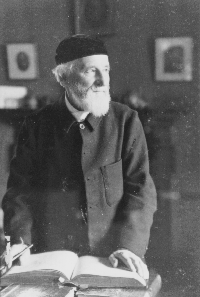
Edwin Abbott Abbott was an English schoolmaster, theologian, and Anglican priest, best known as the author of the novella Flatland (1884).

More by Edwin Abbott Abbott

View all →
Quote
"I devoted several months in privacy to the composition of a treatise on the mysteries of Three Dimensions. Only, with the view of evading the Law, if possible, I spoke not of a physical Dimension, but of a Thoughtland whence, in theory, a Figure could look down upon Flatland and see simultaneously the insides of all things, and where it was possible that there might be supposed to exist a Figure environed, as it were, with six Squares, and containing eight terminal Points. But in writing this book I found myself sadly hampered by the impossibility of drawing such diagrams as were necessary for my purpose... my life was under a cloud. All pleasures palled upon me; all sights tantalized and tempted me to outspoken treason, because I could not but compare what I saw in Two Dimensions with what it really was if seen in Three, and could hardly refrain from making my comparisons aloud. I neglected my clients and my own business to give myself to the contemplation of the mysteries which I had once beheld, yet which I could impart to no one, and found daily more difficult to reproduce even before my own mental vision."
Edwin Abbott AbbottEdwin Abbott Abbott
Quote
"When our Lord uttered (or implied) the words "Do this in remembrance of me," He meant "Do as I am doing." And what He was doing was not a mere "dealing" of "bread" but a "drawing out" of the "soul." This view does not deny that He also contemplated a continuous celebration of the evening meal of thanksgiving in future generations; but it asserts something more, namely, that He meant a spiritual act, "Draw out your souls to one another, and for one another, according to your ability, even as I give my soul, my complete self, delivering it up to you as a gift, and for you as a sacrifice." There is nothing contrary to history and historical development in the belief that Christ taught this doctrine — of self-sacrifice, or losing the soul, of giving the soul as a ransom for others, or drawing out the soul to those in need of help."
Edwin Abbott AbbottEdwin Abbott Abbott
Quote
"Nature herself supplies us with an ascending scale or Alphabet of angles for half a degree up to 60 degrees, Specimens of which are placed in every Elementary School throughout the land. Owing to occasional retrogressions, to still more frequent moral and intellectual stagnation, and to the extraordinary fecundity of the Criminal and Vagabond Classes, there is always a vast superfluity of individuals of the half degree and single degree class, and a fair abundance of Specimens up to 10 degrees. These are absolutely destitute of civic rights; and a great number of them, not having even intelligence enough for the purposes of warfare, are devoted by the States to the service of education. Fettered immovably so as to remove all possibility of danger, they are placed in the class rooms of our Infant Schools, and there they are utilized by the Board of Education for the purpose of imparting to the offspring of the Middle Classes that tact and intelligence of which these wretched creatures themselves are utterly devoid."
Edwin Abbott AbbottEdwin Abbott Abbott
Quote
"As soon as the sound of the Peace-cry of my departing Wife had died away, I began to approach the Stranger with the intention of taking a nearer view and of bidding him be seated: but his appearance struck me dumb and motionless with astonishment. Without the slightest symptoms of angularity he nevertheless varied every instant with gradations of size and brightness scarcely possible for any Figure within the scope of my experience. The thought flashed across me that I might have before me a burglar or cut-throat, some monstrous Irregular Isosceles, who, by feigning the voice of a Circle, had obtained admission somehow into the house, and was now preparing to stab me with his acute angle."
Edwin Abbott AbbottEdwin Abbott Abbott

More on Time

View all →
Quote
"History is a strange experience. The world is quite small now; but history is large and deep. Sometimes you can go much farther by sitting in your own home and reading a book of history, than by getting onto a ship or an airplane and traveling a thousand miles. When you go to Mexico City through space, you find it a sort of cross between modern Madrid and modern Chicago, with additions of its own; but if you go to Mexico City through history, back only 500 years, you will find it as distant as though it were on another planet: inhabited by cultivated barbarians, sensitive and cruel, highly organized and still in the Copper Age, a collection of startling, of unbelievable contrasts."
G
Gilbert Highet
Quote
"As soon as a thought or word becomes a tool, one can dispense with actually ‘thinking’ it, that is, with going through the logical acts involved in verbal formulation of it. As has been pointed out, often and correctly, the advantage of mathematics—the model of all neo-positivistic thinking—lies in just this ‘intellectual economy.’ Complicated logical operations are carried out without actual performance of the intellectual acts upon which the mathematical and logical symbols are based. … Reason … becomes a fetish, a magic entity that is accepted rather than intellectually experienced."
M
Mathematics