SHAWORDS

It is commonly observed — but not commonly enough! — that old folks re — Daniel Dennett

"It is commonly observed — but not commonly enough! — that old folks removed from their homes to hospital settings are put at a tremendous disadvantage, even though their basic bodily needs are well provided for. They often appear to be quite demented — to be utterly incapable of feeding, clothing, and washing themselves, let alone engaging in any activities of greater interest. Often, however, if they are returned to their homes, they can manage quite well for themselves. How do they do this? Over the years, they have loaded their home environments with ultrafamiliar landmarks, triggers for habits, reminder of what to do, where to find the food, how to get dressed, where the telephone is, and so forth. An old person can be a veritable virtuoso of self-help in such a hugely overlearned world, in spite of his or her brains increasing imperviousness to new bouts of learning... Taking them out of their homes is literally separating them from large parts of their minds — potentially just as devastating a development as undergoing brain surgery."
Daniel Dennett
Daniel Dennett
Daniel Dennett
author77 quotes

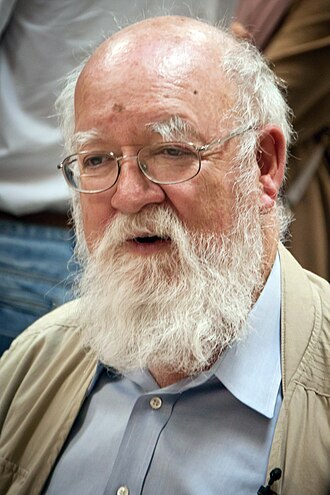
Daniel Clement Dennett III was an American philosopher and cognitive scientist. His research centered on philosophy of mind, philosophy of science, and philosophy of biology, particularly as those fields relate to evolutionary biology and cognitive science.

More by Daniel Dennett

View all →
Quote
"We alone can be wracked with doubt, and we alone have been provoked by that epistemic itch to seek a remedy: better truth-seeking methods. Wanting to keep better track of our food supplies, our territories, our families, our enemies, we discovered the benefits of talking it over with others, asking questions, passing on lore. We invented culture. Then we invented measuring, and arithmetic, and maps, and writing. These communicative and recording innovations come with a built-in ideal: truth. The point of asking questions is to find true answers; the point of measuring is to measure accurately; the point of making maps is to find your way to your destination. … In short, the goal of truth goes without saying, in every human culture."
Daniel DennettDaniel Dennett
Quote
"I have grown accustomed to the disrespect expressed by some of the participants for their colleagues in the other disciplines. "Why, Dan," ask the people in artificial intelligence, "do you waste your time conferring with those neuroscientists? They wave their hands about information processing and worry about where it happens, and which neurotransmitters are involved, but they havent a clue about the computational requirements of higher cognitive functions." "Why," ask the neuroscientists, "do you waste your time on the fantasies of artificial intelligence? They just invent whatever machinery they want, and say unpardonably ignorant things about the brain." The cognitive psychologists, meanwhile, are accused of concocting models with neither biological plausibility nor proven computational powers; the anthropologists wouldnt know a model if they saw one, and the philosophers, as we all know, just take in each others laundry, warning about confusions they themselves have created, in an arena bereft of both data and empirically testable theories. With so many idiots working on the problem, no wonder consciousness is still a mystery. All these charges are true, and more besides, but I have yet to encounter any idiots. Mostly the theorists I have drawn from strike me as very smart people – even brilliant people, with the arrogance and impatience that often comes with brilliance – but with limited perspectives and agendas, trying to make progress on the hard problems by taking whatever shortcuts they can see, while deploring other peoples shortcuts. No one can keep all the problems and details clear, including me, and everyone has to mumble, guess and handwave about large parts of the problem."
Daniel DennettDaniel Dennett
Quote
"Of all the mind tools we acquire in the course of furnishing our brains from the stockpiles of culture, none are more important, of course, than words — first spoken, then written. Words make us more intelligent by making cognition easier, in the same way (many times multiplied) that beacons and landmarks make navigation in the world easier for simple creatures. Navigation in the abstract multidimensional world of ideas is simply impossible without a huge stock of movable, memorable landmarks that can be shared, criticized, recorded, and looked at from different perspectives."
Daniel DennettDaniel Dennett
Quote
"Scientists are just as vulnerable to wishful thinking, just as likely to be tempted by base motives, just as venal and gullible and forgetful as the rest of humankind. Scientists dont consider themselves to be saints; they dont even pretend to be priests (who according to tradition are supposed to do a better job than the rest of us at fighting off human temptation and frailty). Scientists take themselves to be just as weak and fallible as anybody else, but recognizing those very sources of error in themselves and in the groups to which they belong, they have devised elaborate systems to tie their own hands, forcibly preventing their frailties and prejudices from infecting their results."
Daniel DennettDaniel Dennett

More on Sad

View all →
Quote
"We all lament the sad decease of the heroic worker who occupied the post until last week. As you know, his services to the cause were considerable. He organised the great dynamite coup of Brighton which, under happier circumstances, ought to have killed everybody on the pier. As you also know, his death was as self-denying as his life, for he died through his faith in a hygienic mixture of chalk and water as a substitute for milk, which substance he regarded as barbaric, and as involving cruelty to the cow."
T
The Man Who Was Thursday
Quote
"Present-day computers are designed primarily to solve preformulated problems or to process data according to predetermined procedures. The course of the computation may be conditional upon results obtained during the computation, but all the alternatives must be foreseen in advance. … The requirement for preformulation or predetermination is sometimes no great disadvantage. It is often said that programming for a computing machine forces one to think clearly, that it disciplines the thought process. If the user can think his problem through in advance, symbiotic association with a computing machine is not necessary."
P
Programming
Quote
"We must eliminate that [potential nuclear] threat now before it is too late. But that isnt just a future threat. Saddams existing biological and chemical weapons capabilities pose real threats to America today, tomorrow. … [He] is working to develop delivery systems like missiles and unmanned aerial vehicles that could bring these deadly weapons against U.S. forces and U.S. facilities in the Middle East. He could make these weapons available to many terrorist groups, third parties, which have contact with his government. Those groups, in turn, could bring those weapons into the United States and unleash a devastating attack against our citizens. I fear that greatly."
Iraq and weapons of mass destructionIraq and weapons of mass destruction