Quote
"Already in 1948, observations... agreed with quantum mechanics, not with local realism."
Q
Quantum mechanics"Quantum theory was split up into dialects. Different people describe the same experiences in remarkably different languages. This is confusing even to physicists."
Quantum mechanics is the fundamental physical theory that describes the behavior of matter and of light; its unusual characteristics typically occur at and below the scale of atoms. It is the foundation of all quantum physics, which includes quantum chemistry, quantum biology, quantum field theory, quantum technology, and quantum information science.
"Already in 1948, observations... agreed with quantum mechanics, not with local realism."
"Christian Imbert, to support my project and to act as my thesis advisor. He had advised me to go first to Geneva, to discuss my proposal with John Bell. I got an appointment without delay, and I showed up in Johns office at CERN, quite nervous. While I explained my planned experiment, he listened silently. Eventually, I stopped talking, and the first question came: "Have you a permanent position?" After my positive answer, he started talking of physics, and he definitely encouraged me, making it clear that he would consider the implementation of variable analysers a fundamental improvement. Remembering this first question reminds me both of his celebrated sense of humour and of the general atmosphere at that time about raising questions on the foundations of quantum mechanics. Quite frequently there was open hostility, and in the best case, irony: "quantum mechanics has been vindicated by such a large amount of work by the smartest theorists and experimentalists; how can you hope to find anything with such a simple scheme, in optics, a science of the 19th century?" In addition to starting the experiment, I had then to develop a line of argument to try to convince the physicists I met (and among them some had to give their opinion about funding my project)."
"It is a poorly-kept secret that the grandfathers of quantum mechanics, Bohr, Oppenheimer, Heisenberg, Einstein, de Broglie, Jeans, but in particular Schrödinger were fascinated and inspired by Vedic cosmology."
"Quantum mechanics was, and continues to be, revolutionary, primarily because it demands the introduction of radically new concepts to better describe the world. In addition we have argued that conceptual quantum revolutions in turn enable technological quantum revolutions."
"No other theory of the physical world has caused such consternation as quantum theory, for no other theory has so completely overthrown the previously cherished concepts of classical physics and our everyday apprehension of reality. For philosophers, it has been a romping ground of epistemological adventure of pessimism about sciences ability to expose ultimate truth. For physicists, it has required a confrontation with the nature of physical reality and a heady inhalation of new attitudes. For all scientists and technologists, it has been the key to advances in all fields of endeavor, from genetics to superconductivity. The extraordinary feature of quantum theory is that although we do not understand it, we can apply the rules of calculation it inspires, and compute properties of matter to unparalleled accuracy, in some cases with a precision that exceeds that currently obtained from experiment."
"It is often stated that of all the theories proposed in this century, the silliest is quantum theory. In fact, some say that the only thing that quantum theory has going for it is that it is unquestionably correct."
"I say this to you because we Spaniards are a forgetful people, because we are used to living for the moment, because we do not look back, because we do not know how to see the chain of heroes, because we do not contemplate the sum of sacrifices."
 Francisco Franco
"If it fulfills our hopes, this center will be, at once, a symbol and a reflection and a hope. It will symbolize our belief that the world of creation and thought are at the core of all civilization. Only recently in the White House we helped commemorate the 400th anniversary of Shakespeare. The political conflicts and ambitions of his England are known to the scholar and to the specialist. But his plays will forever move men in every corner of the world. The leaders that he wrote about live far more vividly in his words than in the almost forgotten facts of their own rule. Our civilization, too, will largely survive in the works of our creation. There is a quality in art which speaks across the gulf dividing man from man and nation from nation, and century from century. That quality confirms the faith that our common hopes may be more enduring than our conflicting hostilities. Even now men of affairs are struggling to catch up with the insights of great art. The stakes may well be the survival of civilization. The personal preferences of men in government are not important--except to themselves. However, it is important to know that the opportunity we give to the arts is a measure of the quality of our civilization. It is important to be aware that artistic activity can enrich the life of our people, which really is the central object of Government. It is important that our material prosperity liberate and not confine the creative spirit."
"There was a man and he had eight sons. Apart from that, he was nothing more than a comma on the page of History. Its sad, but thats all you can say about some people."
"Children must be free to think in all directions irrespective of the peculiar ideas of parents who often seal their childrens minds with preconceived prejudices and false concepts of past generations. Unless we are very careful, very careful indeed, and very conscientious, there is still great danger that our children may turn out to be the same kind of people we are."
"A free people will always refuse to put up with preventable poverty. If freedom is to be saved and enlarged, poverty must be ended. There is no other solution. The problem of how to prevent these three forces from coming into head-on collision is the principal study of the more politically conscious Conservative leaders. How can wealth persuade poverty to use its political freedom to keep wealth in power? Here lies the whole art of Conservative politics in the twentieth century."
"Some people are desperately looking for scapegoats, they just dont want to see the truth!" (Jon commenting on the parents that blame music for the violence.)"
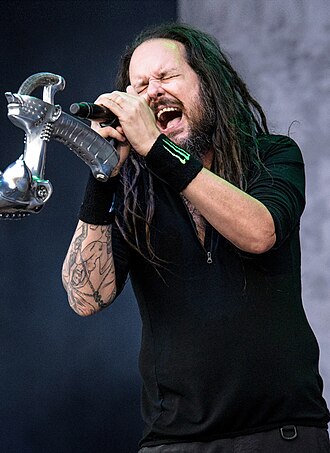 Jonathan Davis