Quote
"The beauty, the spirit of Germany, its sun, moon, stars, rocks, seas and rivers can never be expressed this way.."
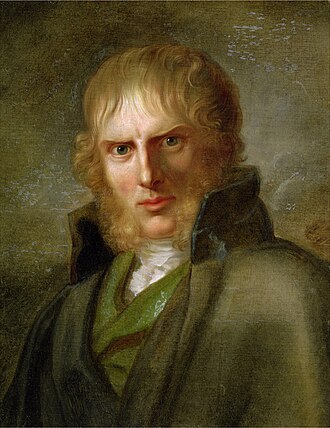 Caspar David Friedrich
"Whenever a storm with thunder and lightning moved over the sea, he would hurry out to the top of the cliffs as if he had a pact of friendship with the forces of nature, or even went on into the oakwood where the lightning had split a tall tree from top to bottom, which led him to murmur: How great, how mighty, how wonderful!"
Caspar David Friedrich was a German Romantic landscape painter, generally considered the most important German artist of his generation, whose often symbolic, and anti-classical work, conveys a subjective, emotional response to the natural world. Friedrich's paintings often set contemplative human figures silhouetted against night skies, morning mists, barren trees or Gothic ruins. Art historian C
"The beauty, the spirit of Germany, its sun, moon, stars, rocks, seas and rivers can never be expressed this way.."
Caspar David Friedrich"Through the gloomy clouds break / Blue sky, sunshine, / On the heights and in the valley / Sing the lark and the nightingale God, I thank you that I live / Not forever in this world / Strengthen me that my soul rise / Upward toward your firmament."
Caspar David Friedrich"Gently rising hills block the view into the distance; line the wishes and desires of the children, who enjoy the blissful moments of the present without wanting to know what lies beyond. Bushes in bloom, nourishing herbs, and sweet-smelling flowers surround the quiet clear stream in which the pure blue of the cloudless sky is reflected like the glorious image of God in the souls of the children.. .There is no stone to be seen here, no withered branch, no fallen leaves. The whole of nature breathes, peace, joy, innocence and life."
Caspar David Friedrich"If a painting has a soulful effect on the viewer, if it puts his mind into a soulful mood, then it has fulfilled the first requirement of a work of art. However bad it might be in drawing, color, handling, etc."
Caspar David Friedrich"Alas, the blue arc of heaven / Is covered with gloomy clouds, / And the bright radiance of the sun / Is completely hidden See the terrifying force of the tempest / Bows the oaks so that is groans, / And the rose on the beautiful pasture / has ben bent down by the rain."
Caspar David Friedrich"I just stepped out of the dark, still forest and found myself on a rising hill. In front of me I saw a valley, surrounded by fertile hills, in which a town stood and the newly covered slate roof of the tower glowed in the evening light. Through the richly-flowered, carpeted meadow the river meandered.. .And behind the hills lay the mountains.. ..cliff after cliff rose far out into the horizon.. .Filled with soaring joy I stood there a long time and looked at the beautiful area.."
Caspar David Friedrich"How seldom, Friend! a good great man inherits Honour or wealth, with all his worth and pains! It sounds like stories from the land of spirits, If any man obtain that which he merits, Or any merit that which he obtains.   . For shame, dear Friend! renounce this canting strain! … Greatness and goodness are not means, but ends! Hath he not always treasures, always friends, The good great man? Three treasures, and , And , regular as infants breath; And three firm friends, more sure than day and night, , his , and the Angel ."
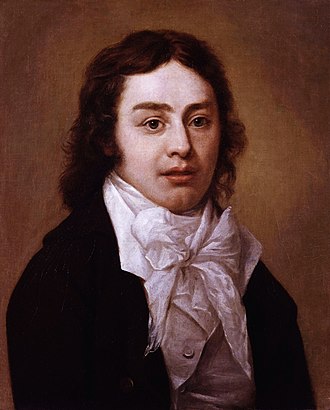 Samuel Taylor Coleridge
"Chronology, the time which changes things, makes them grow older, wears them out, and manages to dispose of them, chronologically, forever. Thank God there is kairos too: again the Greeks were wiser than we are. They had two words for time: chronos and kairos. Kairos is not measurable. Kairos is ontological. In kairos we are, we are fully in isness, not negatively, as Sartre saw the isness of the oak tree, but fully, wholly, positively. Kairos can sometimes enter, penetrate, break through : the child at play, the painter at his easel, Serkin playing the Appassionata are in kairos. The saint in prayer, friends around the dinner table, the mother reaching out her arms for her newborn baby are in kairos. The bush, the , is in kairos, not any burning bush, but the particular burning bush before which Moses removed his shoes; the bush I pass by on my way to the brook. In kairos that part of us which is not consumed in the burning is wholly awake."
"Besides inventing quantum theory, Planck had made another great contribution to science by welcoming and generously supporting the young Albert Einstein. In 1905, when Einstein, then an unknown employee of the Swiss patent office in Bern, sent five revolutionary papers to the physics journal that Planck edited in Berlin, Planck immediately recognized them as works of genius and published them quickly without sending them to referees. He did not agree with all of Einstein’s ideas, but he published all of them. He helped Einstein to move ahead in the academic world, and in 1913 invited him to a full professorship in Berlin. For twenty years Planck and Einstein were friends and colleagues in Berlin, leaders of a scientific community that remained creative and vibrant, in spite of the political and economic disarray that surrounded them. Planck was the rock-solid central figure of German science, with the vision to promote the unorthodox and unpatriotic citizen-of-the-world Einstein."
"One day I was filled with longing To behold in human form the splendours of the Friend, To witness the ocean gathered up into a drop, The sun compressed into a single atom."
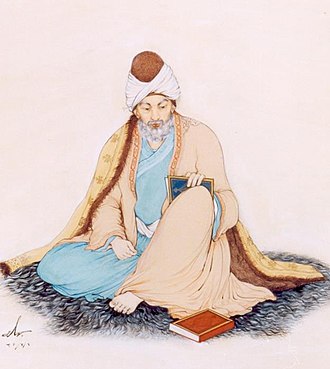 Rumi
Rumi"Our friends from the Trade Federation have pledged their support. And when their battle droids are combined with yours, we shall have an army greater than any in the galaxy. The Jedi will be overwhelmed. The Republic will agree to any demands we make."
 Star Wars: Episode II – Attack of the Clones
"Although my heart may be weak, its not alone. Its grown with each new experience. And its found a home with all the friends Ive made. Ive become a part of their heart, just as theyve become a part of mine. And if they think of me now and then, if they dont forget me, then our hearts will be one. I dont need a weapon. My friends are my power!"
 Kingdom Hearts