SHAWORDS
F

Francis Galton

Francis Galton

Francis Galton

author
35Quotes

Sir Francis Galton was an English polymath and the originator of eugenics during the Victorian era; his ideas later became the basis of behavioural genetics.

Popular Quotes

35 total
Quote
"As these lines are being written, the circumstances under which I first clearly grasped the important generalisation that the laws of Heredity were solely concerned with deviations expressed in statistical units, are vividly recalled to my memory. It was in the grounds of Naworth Castle, where an invitation had been given to ramble freely. A temporary shower drove me to seek refuge in a reddish recess in the rock by the side of the pathway. There the idea flashed across me, and I forgot everything else for a moment in my great delight."
F
Francis Galton
Quote
"[W]e have to get rid of the common illusion that the axioms of moral conduct, which are or appear to be natural to ourselves, must be those of every other sane and reasonable human being. The very existence of the Anthropological Institute should be construed into a standing protest against such narrowness of view. The world of human mind and instinct is richly variegated, persons even of the same sex and race differing sometimes more widely than ordinary men differ from ordinary women, though of course in other ways, and this amount of difference is indeed large. Foreigners say that we are stiff, and that our naturally narrow powers of sympathy are still further contracted by insular prejudices. Be this as it may, it is certain that the English do not excel in winning the hearts of other nations. They have to broaden their sympathies by the study of mankind as they are, and without prejudice. This is precisely what the Anthropologists of all nations aim at doing, and in consequence they continually succeed in discovering previously unsuspected connections between the present and past forms of society, between the mind of the child and of the man, and between the customs, creeds, and institutions of barbarians and of civilised peoples. Anthropology teaches us to sympathise with other races, and to regard them as kinsmen rather than aliens. In this aspect it may be looked upon as a pursuit of no small political value."
F
Francis Galton
Quote
"I have received in a letter from a friend residing in , , the following account of a remarkably interesting meteorological phenomenon, which is well worth putting on record:— “We had a curious sight from this house yesterday [July 26]. It was a dead calm, but in a field just below the garden, with only one hedge between us and it, the hay was whirled up high into the sky, a column connecting above and below, and in the course of the evening we found great patches of hay raining down all over the surrounding meadows and our garden. It kept falling quite four hours after the affair. There was not a breath of air stirring as far as we could see, except in that one spot.”"
F
Francis Galton
Quote
"General impressions are never to be trusted. Unfortunately when they are of long standing they become fixed rules of life and assume a prescriptive right not to be questioned. Consequently those who are not accustomed to original inquiry entertain a hatred and horror of statistics. They cannot endure the idea of submitting sacred impressions to cold-blooded verification. But it is the triumph of scientific men to rise superior to such superstitions, to desire tests by which the value of beliefs may be ascertained, and to feel sufficiently masters of themselves to discard contemptuously whatever may be found untrue."
F
Francis Galton
Quote
"I know of scarcely anything so apt to impress the imagination as the wonderful form of cosmic order expressed by the "Law of Frequency of Error." The law would have been personified by the Greeks and deified, if they had known of it. It reigns with serenity and in complete self-effacement amidst the wildest confusion. The huger the mob, and the greater the apparent anarchy, the more perfect is its sway. It is the supreme law of Unreason. Whenever a large sample of chaotic elements are taken in hand and marshalled in the order of their magnitude, an unsuspected and most beautiful form of regularity proves to have been latent all along. The tops of the marshalled row form a flowing curve of invariable proportions; and each element, as it is sorted into place, finds, as it were, a pre-ordained niche, accurately adapted to fit it."
F
Francis Galton
Quote
"In the earlier part of his memoir, Sir Bartle Frere had compared our mode of treating uncivilized races to that of the Romans. He heartily wished that the resemblance held in certain essential points. Our military hold was as firm, our tolerance of local customs was as great, our dealings were as just, and more just than theirs. But we did not amalgamate with them as the Romans did, we did not intermarry; by means of our missionaries we pressed upon them a form of religion which was not the most congenial. Our civilization was stiff. This, and much more, was pointed out in a very able and most pathetic memoir by Mr. Blyden, the present Minister of Liberia to England, who is a full-blooded negro. The article appeared in Frazer’s Magazine some years ago, and it showed the repressive effect of White civilization upon the Negroes, as contrasted with that of the Mohammedans. It was a shame to us as an Imperial nation, that representatives of the many people whom we governed, did not find themselves more at home among us. They seldom appeared in such meetings as the present one; they did not come to England. We did not see them in the streets. It was very different in ancient Rome, where the presence of foreigners from all parts of the then known world was a characteristic feature of every crowd. He did not now suggest any action, but merely wished to lay stress on this serious drawback to our national character as rulers of a great Empire. He thought they were greatly indebted to Sir Bartle Frere for introducing to public notice so important a subject as the best form of conduct of civilized races towards their less civilized neighbours, and he trusted that it would meet with that full and many-sided discussion which so important a question deserved."
F
Francis Galton
Quote
"I said what I have to say about the modern use of the word "genius" in the preface to the second edition of my "Hereditary Genius." It has only latterly lost its old and usual meaning, which is preserved in the term of an "ingenious" artisan, and has come to be applied to something akin to inspiration. This simply means, as I suppose, though some may think differently, that the powers of unconscious work possessed by the brain are abnormally developed in them. The heredity of these powers has not, I believe, been as yet especially studied. It is strange that more attention has not been given until recently to unconscious brain work, because it is by far the most potent factor in mental operations. Few people, when in rapid conversation, have the slightest idea of the particular form which a sentence will assume into which they have hurriedly plunged, yet through the guidance of unconscious cerebration it develops itself grammatically and harmoniously. I write on good authority in asserting that the best speaking and writing is that which seems to flow automatically shaped out of a full mind."
F
Francis Galton
Quote
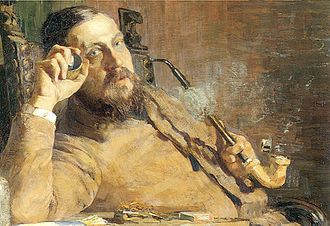
"Galtons passion shows itself best, I feel, in two essays that may seem more frivolous to us than they did to him. In the first, he computed the additional years of life enjoyed by the Royal Family and the clergy because of the prayers offered up for them by the greater part of the population; the result was a negative number. In the second, to relieve the tedium of sitting for a portrait painter, on two different occasions he computed the number of brush strokes and found about 20,000 to the portrait; just the same number, he calculated, as the hand movements that went into the knitting of a pair of socks."
F
Francis Galton
Quote
"Mr. F. Galton would refer first to the purely ethnological part of the memoir, which dwelt upon the difficulty of defining the Bantu race. He thought that ethnologists were apt to look upon race as something more definite than it really was. He presumed it meant no more than the average of the characteristics of all the persons who were supposed to belong to the race, and this average was continually varying. The popular notion seemed based upon some idea like that of a common descent of the different races, from a parent Noachian stock, whence the aborigines of each county were derived, and where they lived in unchanged conditions till the white man came. Nothing can be further from the truth. We know how in South Africa the Bantu population has been in constant seethe and change; how, in much less than a single century, Chaka and his tribe, Mosilekatse and his tribe, and others, have in turn become prominent nations, and the average of the whole Bantu population must thereby have differed at different times. This same fluctuation of the average qualities of the population must, for anything we can see to the contrary, have gone on for many thousands of years. He therefore thought the phrase of Bantu race, as signifying some invariable and definite type, to be a mere chimera."
F
Francis Galton
Quote
"The number of strokes of the paint brush that go to making a picture is of some scientific interest, so I venture to record two personal experiences. Some years ago I was painted by , a well known German artist, when, finding it very tedious to sit doing nothing, I amused myself by counting the number of strokes per minute that he bestowed on the portrait. He was methodical, and it was easy to calculate their average number, and as I knew only too well the hours, and therefore the number of minutes, I sat to him, the product of the two numbers gave what I wanted to learn. It was 20,000. A year and a half ago I was again painted by the late lamented artist , whose method was totally different from that of Graef. He looked hard at me, mixing his colours the while, then, dashing at the portrait, made his dabs so fast that I had to estimate rather than count them. Proceeding as before, the result, to my great surprise, was the same, 20,000. Large as this number is, it is less than the number of stitches in an ordinary pair of knitted socks. In mine there are 100 rows to each 7 inches of length, and 102 stitches in each row at the widest part. Two such cylinders, each 7 inches long, would require 20,000 stitches, so the socks, though they are only approximately cylinders, but much more than 7 inches long, would require more than that number."
F
Francis Galton

Similar Authors & Thinkers