Quote
"Lignorance et lerreur sont nécessaires à la vie comme le pain et leau."
A
Anatole FranceAnatole France
Anatole France
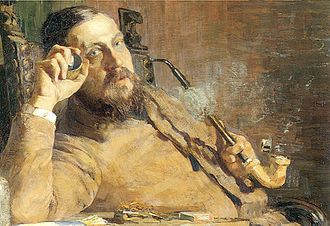
Anatole France was a French poet, journalist, and novelist with several best-sellers. Ironic and skeptical, he was considered in his day the ideal French man of letters. He was a member of the Académie Française, and won the 1921 Nobel Prize in Literature "in recognition of his brilliant literary achievements, characterized as they are by a nobility of style, a profound human sympathy, grace, and
"Lignorance et lerreur sont nécessaires à la vie comme le pain et leau."
"The great human asset is man himself. In order to rate the terrestrial globe, it is necessary to begin by rating men. To exploit the soil, the mines, the waters, all the substances and all the forces of our planet, it needs man, the whole of man; humanity, the whole of humanity. The complete exploitation of the terrestrial globe demands the united labour of white, yellow, and black men. By reducing, diminishing, and weakening, or, to sum it up in one word, by colonising a portion of humanity, we are working against ourselves. It is to our advantage that yellow and black men should be powerful, free, and wealthy. Our prosperity and our wealth depend on theirs. The more is produced, the more will there be consumed. The greater the profit they derive from us, the greater the profit we shall derive from them. If they reap the benefit of our labours, so shall we fully reap theirs. If we study the movements which govern the destinies of societies, we may perhaps discover signs that the era of violent deeds is coming to an end. War, which was formerly a standing institution among nations, is now intermittent, and the periods of peace have become of longer duration than those of war."
"Zita told him of the black standards assembled in crowds in all the waste places of the globe; of the deliverance premeditated and prepared in the provinces of Heaven, where the first revolt had long ago been fomented. "Prince," she went on, "your army awaits you. Come, lead it on to victory.""Friends," replied the great archangel, "I was aware of the object of your visit. Baskets of fruit and honeycombs await you under the shade of this mighty tree. The sun is about to descend into the roseate waters of the Sacred River. When you have eaten, you will slumber pleasantly in this garden, where the joys of the intellect and of the senses have reigned since the day when I drove hence the spirit of the old Demiurge. To-morrow I will give you my answer."
"The holy man, persuaded that they belonged to some idolatrous people and that in their own language they gave adherence to the Christian faith, invited them to receive baptism. "I think," said he to them, "that you bathe often, for all the hollows of the rocks are full of pure water, and as I came to your assembly I saw several of you plunging into these natural baths. Now purity of body is the image of spiritual purity." And he taught them the origin, the nature, and the effects of baptism. "Baptism," said he to them, "is Adoption, New Birth, Regeneration, Illumination." And he explained each of these points to them in succession. Then, having previously blessed the water that fell from the cascades and recited the exorcisms, he baptized those whom he had just taught, pouring on each of their heads a drop of pure water and pronouncing the sacred words. And thus for three days and three nights he baptized the birds."
"The archangel Michael took supreme command. He reassured their minds by his serenity. His countenance, wherein his soul was visible, expressed contempt for danger. By his orders, the chiefs of the thunderbolts, the Kerûbs, grown dull with the long interval of peace, paced with heavy steps the ramparts of the Holy Mountain, and, letting the gaze of their bovine eyes wander over the glittering clouds of their Lord, strove to place the divine batteries in position. After inspecting the defences, they swore to the Most High that all was in readiness. They took counsel together as to the plan they should follow. Michael was for the offensive. He, as a consummate soldier, said it was the supreme law. Attack, or be attacked, — there was no middle course. "Moreover," he added, "the offensive attitude is particularly suitable to the ardour of the Thrones and Dominations." Beyond that, it was impossible to obtain a word from the valiant chief, and this silence seemed the mark of a genius sure of himself."
"The garrison laid down their arms before Satan. Michael placed his flaming sword at the feet of the conquering archangel. "Take back your sword, Michael," said Satan. "It is Lucifer who yields it to you. Bear it in defence of peace and law." Then letting his gaze fall on the leaders of the celestial cohorts, he cried in a ringing voice: "Archangel Michael, and you, Powers, Thrones, and Dominations, swear all of you to be faithful to your God." "We swear it," they replied with one voice. And Satan said: "Powers, Thrones, and Dominations, of all past wars, I wish but to remember the invincible courage that you displayed and the loyalty which you rendered to authority, for these assure me of the steadfastness of the fealty you have just sworn to me."
"If by Realism we mean Truth, which alone gives value to any study of human nature, we have in Anatole France a very dainty realist: — if by Romanticism we understand that unconscious tendency of the artist to elevate truth itself beyond the range of the familiar, and into the emotional realm of aspiration, then Anatole France is at times a romantic. And, nevertheless, as a literary figure he stands alone; neither by his distinctly Parisian refinement of method, nor yet by any definite characteristic of style, can he be successfully attached to any special group of writers."
"The following day, on the ethereal plain, Satan commanded the black standards to be distributed to the troops, and the winged soldiers covered them with kisses and bedewed them with tears. And Satan had himself crowned God. Thronging round the glittering walls of Heavenly Jerusalem, apostles, pontiffs, virgins, martyrs, confessors, the whole company of the elect, who during the fierce battle had enjoyed delightful tranquillity, tasted infinite joy in the spectacle of the coronation. The elect saw with ravishment the Most High precipitated into Hell, and Satan seated on the throne of the Lord. In conformity with the will of God which had cut them off from sorrow they sang in the ancient fashion the praises of their new Master."
"Satan, piercing space with his keen glance, contemplated the little globe of earth and water where of old he had planted the vine and formed the first tragic chorus. And he fixed his gaze on that Rome where the fallen God had founded his empire on fraud and lie. Nevertheless, at that moment a saint ruled over the Church. Satan saw him praying and weeping. And he said to him: "To thee I entrust my Spouse. Watch over her faithfully. In thee I confirm the right and power to decide matters of doctrine, to regulate the use of the sacraments, to make laws and to uphold purity of morals. And the faithful shall be under obligation to conform thereto. My Church is eternal, and the gates of hell shall not prevail against it. Thou art infallible. Nothing is changed." And the successor of the apostles felt flooded with rapture. He prostrated himself, and with his forehead touching the floor, replied: "O Lord, my God, I recognise Thy voice! Thy breath has been wafted like balm to my heart. Blessed be Thy name. Thy will be done on Earth, as it is in Heaven. Lead us not into temptation, but deliver us from evil."
"It was high time for a generous benefactor to come to the relief of our necessities. Rich and poor, learned and ignorant are turning away from us. And when we try to lead back these misguided souls, neither threats nor promises, neither gentleness nor violence, nor anything else is now successful. The Penguin clergy pine in desolation; our country priests, reduced to following the humblest of trades, are shoeless, and compelled to live upon such scraps as they can pick up. In our ruined churches the rain of heaven falls upon the faithful, and during the holy offices they can hear the noise of stones falling from the arches. The tower of the cathedral is tottering and will soon fall. St. Orberosia is forgotten by the Penguins, her devotion abandoned, and her sanctuary deserted. On her shrine, bereft of its gold and precious stones, the spider silently weaves her web."
"Penguinia gloried in its wealth. Those who produced the things necessary for life, wanted them; those who did not produce them had more than enough. "But these," as a member of the Institute said, "are necessary economic fatalities." The great Penguin people had no longer either traditions, intellectual culture, or arts. The progress of civilisation manifested itself among them by murderous industry, infamous speculation, and hideous luxury. Its capital assumed, as did all the great cities of the time, a cosmopolitan and financial character. An immense and regular ugliness reigned within it. The country enjoyed perfect tranquillity. It had reached its zenith."
"Night hung its blue over the garden. Satan fell asleep. He had a dream, and in that dream, soaring over the earth, he saw it covered with angels in revolt, beautiful as gods whose eyes darted lightning. And from pole to pole one single cry, formed of a myriad cries, mounted towards him, filled with hope and love. And Satan said: "Let us go forth! Let us seek the ancient adversary in his high abode." And he led the countless host of angels over the celestial plains. And Satan was cognizant of what took place in the heavenly citadel. When news of this second revolt came thither, the Father said to the Son: "The irreconcilable foe is rising once again. Let us take heed to ourselves, and in this, our time of danger, look to our defences, lest we lose our high abode." And the Son, consubstantial with the Father, replied: "We shall triumph under the sign that gave Constantine the victory."